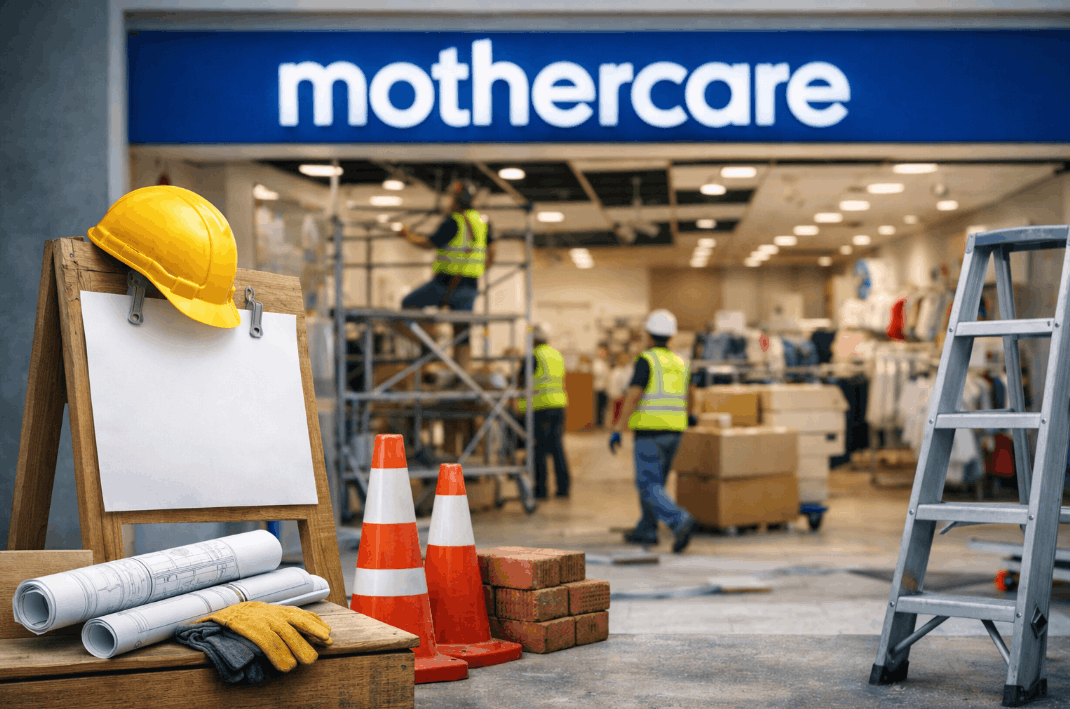
Mothercare Rebuilding UK Presence: The 2026 Asset-Light Strategy and New Partner Roadmap
Mothercare rebuilding UK presence as a licensing-only brand after its exclusive Boots distribution deal ended in December 2025. The company, which has no UK stores of its own, is in active talks with potential new retail partners while its South Asia joint venture with Reliance Brands and Turkey licence with Ebebek keep the wider group stable.
Key Takeaways
- Mothercare’s exclusive 10-year UK distribution deal with Boots ended at the close of 2025, ending its only confirmed UK retail channel for now.
- FY26 group retail sales fell 22% to £180 million, with adjusted EBITDA down to roughly £1.25 million from £3.5 million a year earlier.
- Mothercare’s Reliance Brands joint venture covers South Asia only; its Ebebek licence covers Turkey only, neither is a UK retail deal.
- Net borrowings rose to £5.7 million at year-end March 2026, up from £3.7 million the prior year, alongside a £35 million pension deficit.
How is Mothercare rebuilding its UK presence in 2026?
The 2026 strategy is less a single rollout than a rebuild-from-scratch effort. Mothercare’s exclusive UK distribution deal with Boots, running since 2020, ended at the close of 2025, the company said this reflected a greater opportunity for the brand and a new partner in the UK, but as of its most recent trading update it has no confirmed UK retail partner in place. It says it remains in discussions with several parties to restore critical mass.
The confirmed international deals sometimes cited alongside this, a joint venture with Reliance Brands and a licence with Ebebek, are not UK retail arrangements.
The Ebebek deal gives the Turkish retailer exclusive Mothercare brand rights inside Turkey only. Both have helped stabilise group finances, which in turn supports the search for a UK partner, but neither puts Mothercare products back on UK shelves directly.
The Shift from Survival to Scalable Growth
The current trajectory represents a calculated move away from the emergency measures of 2019. The current momentum is the result of a multi-year balance sheet restructuring, meticulously designed to facilitate this specific phase of market re-entry.
By shedding all 79 UK standalone stores during the 2019 administration, the management team repositioned the company as a brand owner rather than a shopkeeper.
That franchise-only model has since expanded internationally, but in the UK specifically, franchise partner numbers have kept falling too: Mothercare’s global store count dropped from 440 to 344 over the year to September 2025, with UK-specific coverage now at zero standalone stores and reliant entirely on whichever partner takes on the brand next.
Recognising this shift in identity, from a property-heavy retailer to a strategic brand curator, is central to the 2026 growth story.
The goal is no longer to compete on every corner, but to be present wherever the modern parent shops, combining digital convenience with high-quality physical touchpoints.

Who introduced the Mothercare rebuilding UK presence strategy?
The strategic blueprint for the brand’s resurrection was introduced and championed by Chairman Clive Whiley. Appointed during the 2019 crisis, Whiley implemented a Transformation Plan designed to insulate the brand from the volatility of UK retail rents.
By negotiating complex debt facilities and securing international partners, Whiley’s leadership shifted the company toward the current franchise-heavy model, a shift documented in Mothercare plc’s own filing history as a public company.
Steps in the Mothercare Turnaround Process
- Administration & Store Closure: Exiting the traditional high-street lease model in 2019 to stop cash haemorrhage.
- The Boots Residency: Establishing a five-year exclusive partnership to maintain brand visibility and cash flow.
- Debt Refinancing: Securing the February 2026 deal to reduce high-interest burdens and clear the path for new investment.
- Global Partnership Expansion: A joint venture with Reliance Brands, covering brand ownership and IP across South Asia and the UK (Reliance Brands holds 51%, Mothercare 49%, for a £16 million cash consideration).
- International Licensing: A 10-year exclusive licence with Turkish retailer Ebebek, covering brand use within Turkey only.
- Multi-Channel Launch: Rolling out the 2026 shop-in-shop concepts across various UK retailers.
- Digital Optimisation: Rebuilding the web interface to integrate seamlessly with new third-party distribution points.
Is Mothercare still in Boots as of 2026?
No. The exclusive ten-year deal with Boots, which began in 2020, ended at the close of 2025. Mothercare said the split reflected a greater opportunity for the brand and a new partner in the UK, but no successor deal has been confirmed as of its FY26 trading update (year ending 28 March 2026).
Until a new partner is named, Mothercare has no confirmed UK retail shelf presence.
Understanding the Evolving Distribution Network
The end of exclusivity is a strategic release valve. When reviewing decisions made by heritage brands, it is a common pattern to see exclusivity used for stability, while non-exclusivity is used for scaling.
For example, a parent in a mid-sized town who previously had to travel to a flagship Boots may soon find Mothercare-branded nursery furniture and clothing in local independent boutiques or larger department store concessions.
| Feature | The Boots Era (2020–2025) | The Rebuild Era (2026 onwards) |
|---|---|---|
| Exclusivity | Fully exclusive UK franchise | No exclusive UK partner confirmed |
| UK retail presence | Branded shelving in 400+ Boots stores | None currently confirmed |
| Group revenue driver | UK + Middle East (Alshaya) franchise sales | South Asia JV (Reliance) and Turkey licence (Ebebek) |
| FY sales trend | Franchise sales broadly stable | FY26 group sales down 22% to £180m |
| Net borrowings | £3.7m (March 2025) | £5.7m (March 2026) |
How does the asset-light model support Mothercare rebuilding UK presence?
The Mothercare rebuilding UK presence strategy relies entirely on an asset-light framework. This means the company does not own the buildings, the trucks, or the stock in the stores.
Instead, they own the Mothercare trademark and design specifications, which they license to partners like Reliance and Ebebek. This protects the company from the rising costs that have pushed many high-street retailers toward business rates relief schemes and energy-cost pressures of their own.
The Impact of the 2026 Refinancing
Mothercare completed a full refinancing of its debt facilities in February 2026, which chairman Clive Whiley described as buying additional time to engineer a more comprehensive solution to harvest the value of the brand IP.
The £17.1m-to-£5.8m debt reduction often cited alongside this actually happened earlier, net debt was cut to £5.8 million by the half-year point (27 September 2025), down from £17.1 million the year before, largely via the South Asia and Turkey deals rather than the February refinancing itself.
By the FY26 year-end (28 March 2026), net borrowings had risen again to £5.7 million, up from £3.7 million a year earlier, and the group still carries a £35 million pension scheme deficit, the kind of widening gap between paper position and cash reality that a rolling cash flow forecast is designed to catch early.
The refinancing bought time rather than resolving the debt position outright; it has not yet, on its own, triggered any new UK distribution contracts.
- IP Protection: Focus remains on high-quality product design and safety standards.
- Reduced Overhead: No direct staff costs or property maintenance in the UK.
- Scalability: New partners can be added quickly without capital expenditure.

Where can parents find Mothercare products in the UK today?
Finding Mothercare products is becoming easier as the brand integrates into various store-within-a-store concepts. Rather than searching for a standalone Mothercare sign, parents should look for dedicated zones within larger retail environments.
Who’s filling the UK gap while Mothercare rebuilds
While Mothercare has no confirmed UK shelf presence, its own Turkish licensing partner has quietly started competing in the same market: Ebebek opened its first UK stores in 2025, including what it’s called the UK’s largest baby-and-parent store, trading independently of the Mothercare brand.
Meanwhile, UK-based rivals like Mamas & Papas and Silver Cross have continued operating standalone UK stores throughout the period Mothercare has had none, a genuine competitive pressure point any 2026 UK rebuild has to overcome, not just brand nostalgia.
Rebuilding Trust with the Modern Parent
A common challenge in a Mothercare rebuilding UK presence is overcoming the Trust Gap left by the 2019 closures. Consider a mother in Manchester who bought a car seat in 2018; when the stores closed, she felt abandoned regarding warranties and advice.
The 2026 strategy addresses this by partnering with retailers known for high levels of customer service, ensuring that technical nursery products come with the necessary face-to-face guidance.
- Regional Concessions: Expanding into regional department stores to reach suburban areas.
- Specialist Nurseries: Partnering with independent local shops to stock premium furniture ranges.
- Enhanced Web Experience: A revitalised direct-to-consumer website with better logistical tracking.
Final summary
Mothercare’s UK story right now is a gap, not yet a comeback: the Boots deal that was its only UK retail channel ended at the close of 2025, and no replacement has been confirmed.
The company’s stronger footing internationally, the Reliance Brands joint venture in South Asia and the Ebebek licence in Turkey, has helped stabilise its finances and buy time via the February 2026 refinancing, but neither puts products on UK shelves.
For now, UK parents looking for Mothercare-branded goods should expect a gap until a new UK partner is named, while checking Mothercare’s own site and franchise partner announcements for updates.
FAQ
Does Mothercare still exist in the UK?
Yes, as a brand and licensing business. Mothercare plc still trades on the London Stock Exchange and owns the brand and IP, but it operates no UK stores directly and currently has no confirmed UK retail distribution partner.
Is Mothercare UK closed down?
Mothercare’s UK retail arm closed in 2019 when all 79 stores went into administration. The brand continued via a Boots franchise deal from 2020, which ended in December 2025, leaving no current UK shelf presence.
Who bought Mothercare UK?
No single buyer took over UK retail operations. Mothercare Global Brand Limited retained the brand and IP, licensing it out, first to Boots (2020–2025), and to international partners including Reliance Brands (South Asia) and Ebebek (Turkey).
Where is the head office of Mothercare PLC?
Mothercare’s operational headquarters was historically Cherry Tree Road, Watford, though that building was sold in a 2019 leaseback deal. Its current registered office with Companies House is in Weybridge, Surrey.
Is the Early Learning Centre part of the Mothercare rebuild?
No. ELC was sold to The Entertainer in March 2019 and has operated as a fully separate business since, with no ownership or strategic ties to Mothercare’s current brand-licensing model.
Will Mothercare open new UK stores in 2026?
Not directly. Its asset-light model relies on franchise and licensing partners to operate physical retail. As of its FY26 update, Mothercare said it remains in talks with potential UK partners but has not confirmed a new deal.