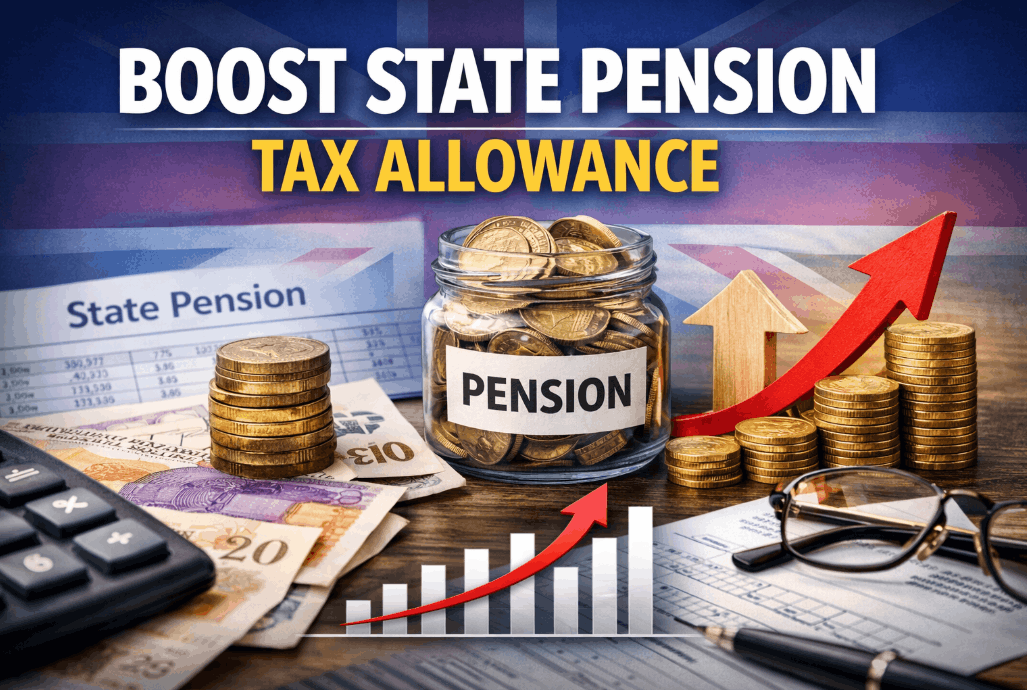
Boost State Pension Tax Allowance: 5 Legal UK Strategies
As of the 2026/27 tax year, the UK Personal Allowance remains frozen at £12,570 while the New State Pension has risen to approximately £12,548 per year.
To boost state pension tax allowance and protect your retirement income from fiscal drag, you must actively apply for supplemental reliefs like the Marriage Allowance or Blind Person’s Allowance, which can legally increase your tax-free threshold by thousands of pounds.
5 Ways to Legally Boost Your Tax-Free Threshold in 2026
If your total income is approaching the £12,570 limit, you can use these five statutory reliefs and financial strategies to shield your pension:
- Marriage Allowance: Transfer £1,260 of a spouse’s unused allowance to your own tax code.
- Blind Person’s Allowance: Add a significant £3,070 boost to your threshold if you are registered as sight-impaired.
- The Net Income SIPP Trick: Lower your taxable income by making private pension contributions to trigger tax relief.
- Tax-Free ISA Bridging: Draw income from ISAs instead of taxable pensions to keep your total earnings below the tax bracket.
- Starter Rate for Savings: Utilise the £5,000 tax-free interest band designed specifically for those with lower pension incomes.
How to Boost Your State Pension Tax Allowance in 2026: A Complete UK Guide
The frozen Personal Allowance of £12,570 has created a unique tax trap for millions of UK retirees.
Because the New State Pension is now within just £22 of the tax-free limit, almost any other form of income, such as a small private pension, part-time earnings, or even significant savings interest—will trigger a tax bill.
This squeezing of retiree income is a direct consequence of the pension triple lock providing necessary annual increases while the personal allowance remains stubbornly frozen.
Understanding how to expand your tax-free boundaries is no longer optional; it is a vital part of modern retirement strategy.
Identifying the 2026/27 Retirement Tax Gap
In my experience assisting those nearing retirement, the biggest shock often comes from Simple Assessment letters.
HMRC uses this system to collect tax when your State Pension exceeds your allowance, but you don’t have a PAYE job or private pension provider to deduct the tax automatically.
With the current freeze on thresholds lasting until 2028, the real-world value of your pension is being eroded by the taxman unless you utilise specific statutory boosts.

Legally Expanding Your Tax-Free Boundaries via Statutory Reliefs
To effectively boost state pension tax allowance levels, you should look beyond the standard £12,570 Personal Allowance and identify if you qualify for the Marriage Allowance or Blind Person’s Allowance.
These are the two most powerful ways to instantly increase the amount of income you can receive before HMRC applies the 20% basic rate tax.
The Core Truth About Pensioner Taxation
Many people believe that the State Pension is tax-free because National Insurance isn’t deducted from it. This is a common misconception.
While you stop paying National Insurance once you reach State Pension age, the pension itself is still classed as taxable income. If your total annual income, including the State Pension, exceeds your total available allowances, you will owe income tax.
| Allowance Type | 2026/27 Tax-Free Amount | Who Can Claim? |
| Standard Personal Allowance | £12,570 | Most UK residents |
| Marriage Allowance | + £1,260 | Couples where one earns below £12,570 |
| Blind Person’s Allowance | + £3,070 | Registered blind individuals |
| Total Combined Potential | £16,900 | Eligible individuals with both boosts |
Can the Marriage Allowance increase your tax-free limit?
The Marriage Allowance allows you to transfer 10% of your personal tax allowance to your husband, wife, or civil partner. In practice, I have seen this save retired couples up to £252 per year.
This is particularly effective if one partner has a full New State Pension while the other receives a smaller Old State Pension, a disparity that highlights why many argue the new state pension unfair to existing pensioners due to the inconsistent distribution of benefits.
A Practical Framework for Claiming the Marriage Allowance
- Verify Eligibility: One partner must earn less than the Personal Allowance (£12,570), and the other must be a basic-rate taxpayer.
- Gather Details: You will need both National Insurance numbers and a form of identification (like a UK passport or P60).
- Apply Online: Use the official GOV.UK Marriage Allowance portal.
- Wait for Confirmation: HMRC will change the tax codes for both partners.
- Backdate Your Claim: You can often backdate the claim for up to four previous tax years to receive a refund.
- Automatic Renewal: Once set up, the transfer happens automatically every year unless you cancel it or your circumstances change.

Is the Blind Person’s Allowance Your Most Effective Tax Shield?
If you are registered as blind or severely sight impaired with a local authority (or in Scotland/Northern Ireland, if your sight is poor enough to be registered), you are entitled to the Blind Person’s Allowance. This adds a significant £3,070 to your tax-free threshold for the 2026/27 year.
When reviewing decisions made by HMRC, it is clear that this allowance is often missed by eligible retirees.
If you and your spouse are both eligible, you both get the allowance. Furthermore, if your income is too low to use the full allowance, you can actually transfer the remaining portion to your spouse, effectively boosting their tax-free limit instead.
Consider the situation of a retiree like Arthur, a veteran whose New State Pension and private pension combine for a total income of £15,000. Under normal rules, he would pay tax on £2,430. However, after claiming the Blind Person’s Allowance, his total allowance jumps to £15,640, making his entire income tax-free.
Why pension contributions are still relevant after age 65?
It might sound counter-intuitive to keep paying into a pension once you’ve retired, but it is a legal way to lower your Adjusted Net Income.
For every £80 you contribute to a private pension (SIPP), the government adds £20 in tax relief. More importantly, this contribution reduces the income figure HMRC uses to calculate your tax, potentially keeping you under certain thresholds.
Maintaining contributions remains a savvy tactical move, though it is vital to stay informed on the shifting landscape of UK pension tax reform proposals, which could redefine relief limits sooner than expected.
Strategic Ways to Protect Your Retirement Income
- Utilise your ISA: Withdrawals from an Individual Savings Account (ISA) are 100% tax-free and do not count toward your Personal Allowance limits.
- The 25% Rule: Take your 25% tax-free lump sum from private pensions strategically to cover large expenses rather than drawing taxable monthly income.
- The Starter Rate for Savings: You can earn up to £5,000 in interest tax-free if your other income (like your pension) is low enough.
- Deferring the Pension: If you are still working, deferring your State Pension by just one year increases the eventual payment by 5.8%, which can be a double-edged sword for tax but useful for long-term cash flow.
Managing HMRC Simple Assessment for the 2026/27 tax year
A common pattern I’ve observed in 2026 is the rise of the Simple Assessment. This move toward automated billing aligns with the broader DWP pension bank rules update, granting government departments enhanced oversight of financial accounts to cross-reference benefit claims with tax liabilities.
Critical Year-End Actions for UK Pensioners
- Check your Tax Code: Ensure HMRC hasn’t doubled up your allowance if you have multiple income sources.
- Report Life Changes: Marriage, bereavement, or a new diagnosis of sight loss can all change your allowance.
- Review Interest Statements: Banks now report interest directly to HMRC; ensure your Starting Rate for Savings is being applied correctly.
- Monitor the Triple Lock: As the State Pension rises each April, your buffer above the £12,570 limit shrinks.

Securing Your Retirement Against Fiscal Drag
Boosting your tax-free threshold is the only way to combat the current freeze on tax bands. To stay ahead:
- Calculate your total expected income for the 2026/27 year today.
- Identify if you or your partner qualify for the Blind Person’s or Marriage Allowance.
- Submit your claims via the official GOV.UK portal before the end of the tax year.
- Consult a qualified tax professional if your income exceeds £50,000, as higher-rate tax traps become more complex.
FAQ about boost state pension tax allowance
Can I increase my personal allowance if I am over 66?
Yes, while the Age Allowance was phased out years ago, you can still increase your tax-free limit via Marriage Allowance (£1,260) or Blind Person’s Allowance (£3,070) if you meet the specific health or marital criteria.
Is the state pension taxable in 2026?
Yes. Although the State Pension is paid without tax deducted at source, it counts as taxable income. If your total annual income exceeds £12,570, you will owe tax to HMRC via Simple Assessment or PAYE.
How do I get the extra £1,260 tax allowance?
You must apply for the Marriage Allowance via GOV.UK. This allows the lower-earning partner to transfer 10% of their £12,570 allowance to the higher-earning partner, provided the recipient is a basic-rate taxpayer.
What is the tax-free limit for pensioners in 2026/27?
The standard limit is £12,570. However, by combining the Marriage Allowance and Blind Person’s Allowance, a pensioner’s individual tax-free threshold can legally be boosted to as high as £16,900 per year.
Does Pension Credit affect my tax allowance?
Pension Credit itself is a tax-free benefit and does not count towards your £12,570 Personal Allowance. It is an “income-related” benefit designed to top up your weekly income to a guaranteed minimum level.
Why did I receive a Simple Assessment from HMRC?
HMRC sends these when you owe tax on income that isn’t taxed at source (like the State Pension). In 2026, many pensioners receive these because their State Pension now nearly equals their Personal Allowance.
Can I backdate a tax allowance claim?
Yes, you can usually backdate claims for Marriage Allowance or Blind Person’s Allowance for up to four years. This often results in a significant tax refund cheque from HMRC.