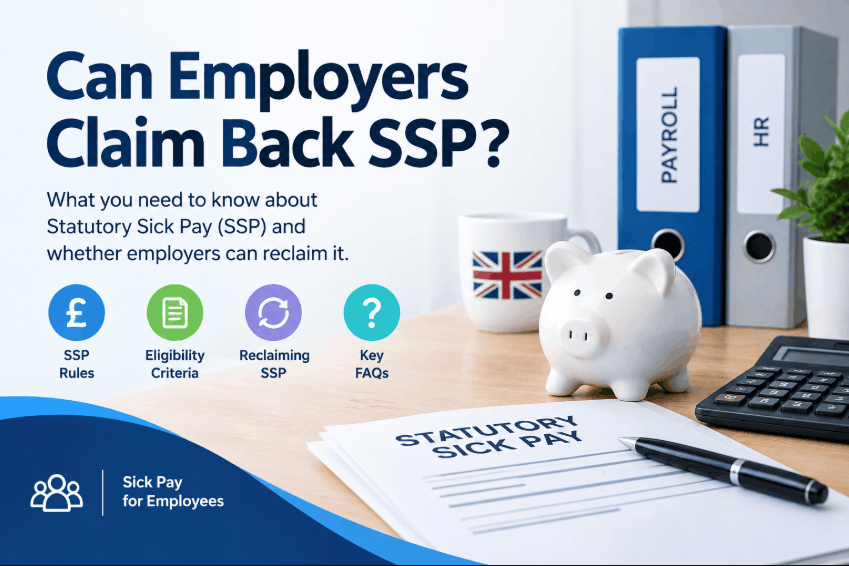
Can Employers Claim Back SSP? 2026 Cost Solutions
Can employers claim back SSP? No. Statutory Sick Pay (SSP) recovery is the right to reclaim sick pay from HMRC. In the 2026/27 tax year, no general route exists. Employers cannot claim back SSP: the Percentage Threshold Scheme ended in 2014, the temporary coronavirus rebate closed in 2022, and payroll funds the full cost.
Key Takeaways
- No general route exists to reclaim Statutory Sick Pay from HMRC in 2026/27.
- SSP is £123.25 a week or 80% of average weekly earnings, whichever is lower, payable from day one for up to 28 weeks.
- Employers can usually reclaim 92% of Statutory Maternity and Paternity Pay, but not SSP.
Can Employers Claim Back SSP? The 2026/27 Answer
No: employers cannot claim back SSP from HMRC or any other government body. No general reclaim mechanism exists, so Statutory Sick Pay is funded directly through payroll. The GOV.UK list of payments employers can reclaim covers family-related statutory pay, and SSP is not on it.
Claiming back SSP from HMRC fails through every route employers commonly try:
- An Employer Payment Summary claim, which recovers only the family-related payments GOV.UK lists.
- A repayment request to the PAYE Employer Office, which also applies to those family-related payments only.
- A small-employer rebate, because no such scheme currently operates.
- Small Employers’ Relief, which raises recovery on statutory family pay but does not extend to SSP.
Pages that say otherwise usually describe two historical recovery schemes that have since closed.
The Two Closed Schemes That Still Cause Confusion
Two schemes once allowed SSP recovery, and both have closed. Older advice still circulates because the closure dates were relatively recent or tied to the pandemic:
- Before 6 April 2014: The Percentage Threshold Scheme let employers recover SSP paid above 13% of their gross Class 1 National Insurance contributions liability in a tax month.
- 6 April 2014: The scheme was abolished, and claims for earlier absences stayed open until April 2016.
- 2020 to 2022: A temporary rebate scheme reimbursed coronavirus-related SSP for smaller employers.
- March 2022: That temporary rebate scheme closed, and nothing has replaced it.
The Coronavirus SSP Rebate Scheme closed to absences after 17 March 2022, and employers could submit or amend claims until 24 March 2022.
It covered up to two weeks of coronavirus-related SSP per employee for employers with fewer than 250 employees. It was temporary, and no equivalent scheme operates in 2026/27.
Many guides still describe these schemes in the present tense, and a few still tell small employers they can reclaim two weeks of SSP.
The GOV.UK coronavirus rebate guidance confirms the scheme has closed. The state does still return money on other statutory payments, which is where much of the confusion starts.

What HMRC Actually Refunds And The Insolvency Exception
HMRC lets employers recover a proportion of Statutory Maternity Pay (SMP) and Statutory Paternity Pay (SPP), but never SSP. Employers can usually reclaim 92% of those payments, or 109% where Small Employers’ Relief applies, according to GOV.UK’s guide to financial help with statutory pay.
The same rates apply to Statutory Adoption Pay, Statutory Shared Parental Pay, Statutory Parental Bereavement Pay and Statutory Neonatal Care Pay.
| Payment | Can the employer reclaim it? | Usual recovery rate | Rate with Small Employers’ Relief |
|---|---|---|---|
| Statutory Sick Pay (SSP) | No | None | None |
| Statutory Maternity Pay (SMP) | Yes | 92% | 109% |
| Statutory Paternity Pay (SPP) | Yes | 92% | 109% |
Small Employers’ Relief applies to employers that paid £45,000 or less in Class 1 National Insurance contributions in the last complete tax year before the qualifying week.
Employment Allowance reductions are ignored when testing that limit. Small employers therefore cannot claim back SSP either, even though they receive a higher rate on family-related pay.
To manage statutory payments properly:
- Reclaiming SMP and SPP: Include the amounts in your Employer Payment Summary through payroll software. If you cannot afford to fund the payments, ask HMRC for an advance.
- Insolvency exception: HMRC pays SSP only for an employee who was already sick when the employer became insolvent. In that situation, the employee contacts HMRC’s Statutory Payment Disputes Team.
Who pays Statutory Sick Pay, the employer or the government, therefore comes down to one rule: the employer pays in every other case.
The Cost of Day-One SSP in 2026/27
The Employment Rights Act 2025 turned SSP into a day-one entitlement on 6 April 2026, and the Lower Earnings Limit no longer applies. The reforms added no reclaim route, so employers cannot claim back SSP in 2026 to offset the extra days.
Before that date, three unpaid waiting days applied, and absences shorter than four days in a row attracted no SSP.
SSP is now the lower of £123.25 a week or 80% of average weekly earnings. It is paid for up to 28 weeks in a period of incapacity for work, per the GOV.UK employer guide. The 80% limb applies to workers averaging less than roughly £154 a week; at £100 a week, for illustration, it gives £80.
Follow these steps to calculate SSP for an absence:
- List the days the worker normally works. These are the qualifying days.
- Find average weekly earnings over the eight weeks before the absence began.
- Take the lower of £123.25 and 80% of that average.
- Divide the result by the number of qualifying days in a normal week.
- Multiply the daily amount by the qualifying days missed.
Illustration: full weekly rate, five-day working week (formula from GOV.UK; not a real case)
| Qualifying days missed | SSP payable at full rate | Position before 6 April 2026 (standalone absence) |
|---|---|---|
| 1 day | £24.65 | No SSP payable |
| 2 days | £49.30 | No SSP payable |
| 3 days | £73.95 | No SSP payable |
| 5 days | £123.25 | First three days unpaid |
| 28 weeks (maximum) | £3,451.00 | First three days unpaid |
Because SSP is a payroll liability with no refund, even one-day absences now carry a cash flow impact. The full cost to the employer is never offset.
Acas explains that transitional protection may keep some workers on the flat £123.25 rate if an absence began before 6 April 2026. This applies to workers earning £125 to £154.05 a week who were already receiving SSP.
Absences eight weeks apart or less link together, so the 28-week limit carries across them, according to Acas. Statutory annual leave also keeps accruing during sickness and can be taken during sick leave, according to GOV.UK.
Can an Employer Refuse to Pay SSP?
Yes, but only where the worker fails the qualifying conditions, because SSP is a legal minimum rather than a discretionary payment. The main grounds for refusal are:
- The worker is not classed as employed for tax purposes, for example because they pay their own tax through Self Assessment.
- The worker has not yet done any work for the employer.
- The worker did not report sickness within the employer’s deadline, or within seven days where no deadline exists.
- The worker has already received 28 weeks of SSP in the same period of incapacity for work.
- The worker is receiving Statutory Maternity Pay at the same time.
If you refuse SSP, give the worker your reasons in writing, either on an SSP1 form or by letter or email. You cannot insist on a fit note during the first seven days of absence, but you may ask for one after that. Refused workers may be able to claim benefits instead, so send the reasons promptly.
Workers who believe SSP was wrongly refused or underpaid can contact HMRC’s Statutory Payment Disputes Team, and HMRC may ask to see the employer’s absence records. The Acas guide to statutory sick pay explains the written-reasons rule and the dispute route.

How Small Employers Can Reduce the Cost of Absence
You cannot reclaim SSP, but you can influence how often absences happen and how long they last. These six steps reduce the cost of absence without cutting anyone’s statutory entitlement:
- Write down the reporting rule. Set a clear reporting deadline in the employment contract or policy, because the default window is seven days.
- Run a return-to-work process. Hold a short conversation after each absence to surface causes early and test whether adjustments would help.
- Use fit notes properly. After seven calendar days, ask for a fit note, which may recommend workplace adjustments or a phased return.
- Keep accurate records. Retain absence dates and medical evidence for three years after the end of the tax year, because HMRC may ask to see them.
- Decide on occupational sick pay deliberately. Write any enhanced sick pay into the contract; paying more than SSP also meets your statutory duty.
- Compare income protection insurance. Policies typically pay only after a deferred period and do not refund SSP already paid, so read the terms before buying.
Budget for SSP as a standing payroll cost, treating £3,451 per employee, the 28-week maximum at the full rate, as the worst case for one long absence.
Review absence patterns each quarter, because tracking how many sick days are taken and catching repeat short absences early is the easiest way to improve basic absence management.
If SSP runs out after 28 weeks, give the worker an SSP1 form so they can claim Employment and Support Allowance.
How to Spot an Outdated SSP Guide
Some guides published in 2026 still carry figures or schemes that no longer apply, and searches such as “can employers claim back SSP 2026″ still surface them:
| Claim still found online | Official position |
|---|---|
| A small-employer rebate scheme reimburses SSP | The Coronavirus SSP Rebate Scheme closed to absences after 17 March 2022 |
| Small Employers’ Relief covers SSP | GOV.UK lists the payments eligible for the relief, and SSP is not among them |
| Employers wait three days before SSP starts | SSP is payable from the first qualifying day since 6 April 2026 |
| Workers must earn a minimum weekly amount | The Lower Earnings Limit was removed on 6 April 2026 |
| Last year’s flat rate still applies | The 2026/27 rate is £123.25 a week, or 80% of average weekly earnings if lower |
| Small employers recover SMP at 103% | GOV.UK states 109% with Small Employers’ Relief |
Check the publication date, the weekly rate and any mention of a rebate before relying on a guide. When in doubt, compare the figure with the GOV.UK employer guide.
Conclusion
Employers cannot claim back SSP in 2026/27: the Percentage Threshold Scheme and the coronavirus rebate have both ended, and the day-one rules raise the payroll cost.
The practical response is to budget for SSP at £123.25 a week, reclaim what HMRC does refund, manage absence early, and check every guide against GOV.UK.
FAQs
Can employers claim back SSP from HMRC?
No. HMRC does not refund Statutory Sick Pay in 2026/27, because the Percentage Threshold Scheme ended on 6 April 2014 and the coronavirus rebate closed in 2022. Employers fund SSP through payroll.
Who bears the cost of Statutory Sick Pay, the employer or the government?
The employer bears the cost in almost every case. HMRC pays SSP only where an employee was already sick when the employer became insolvent.
Can small employers claim back SSP?
No. Small Employers’ Relief lifts recovery on Statutory Maternity and Paternity Pay to 109%. It applies to employers paying £45,000 or less in Class 1 National Insurance contributions, but not to SSP.
Can an employer claim back SPP or SMP?
Yes. Employers can usually reclaim 92% of both, or 109% with Small Employers’ Relief, by reporting them on the Employer Payment Summary.
Disclaimer: This article is for general informational purposes only and does not constitute formal legal, financial, or HR advice; please consult a qualified professional before making payroll decisions.