
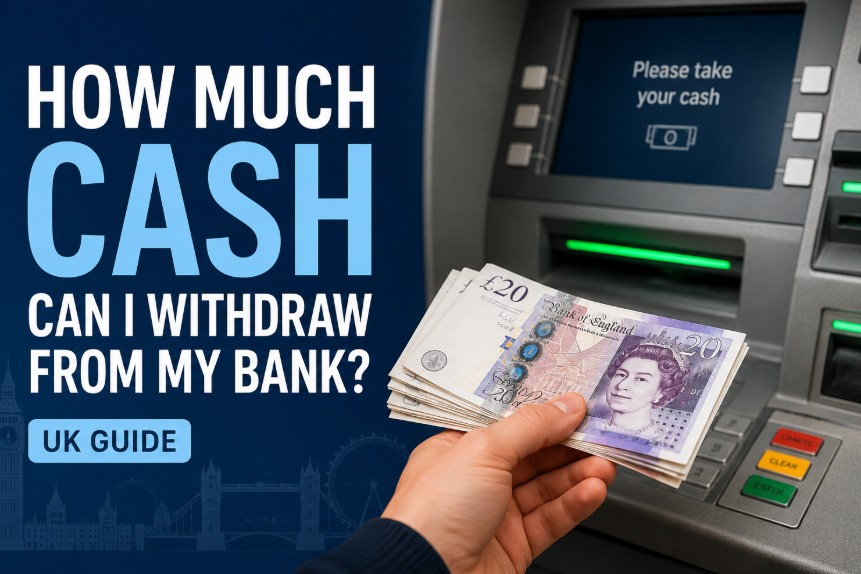
How Much Cash Can I Withdraw From My Bank: ATM Limits, Branch Rules, And Post Office
Determining how much cash you can withdraw from a UK bank depends on the channel used and individual card limits. As of 2026, standard daily ATM caps range from £250 to £500, branch counter withdrawals allow up to £2,500 without notice, and sums over £5,000 require advance notice under Financial Conduct Authority rules.
Key Takeaways
- Standard UK ATM daily withdrawal limits range from £250 to £500 depending on the provider, account type, and personal card security settings selected.
- Over-the-counter branch withdrawals allow higher sums up to £2,500 daily without advance notice, provided valid photographic identification is presented.
- Financial Conduct Authority guidelines require banks to conduct compliance verification interviews for large cash transactions to protect against fraud.
- Withdrawing cash sums exceeding £5,000 from a high-street branch typically requires giving between 24 and 48 hours of advance notice to ensure vault liquidity.
How much cash can I withdraw from my bank today?
You can typically withdraw between £250 and £500 daily from a standard UK ATM, up to £2,500 over the counter at a high-street branch without advance notice, and up to £1,000 at a Post Office counter.
For larger sums exceeding £5,000, banks require between 24 and 48 hours of advance notice and relevant documentation.
Automated Teller Machines (ATMs)
Standard UK automated teller machines (ATMs) restrict daily cash withdrawals to between £250 and £500, with £300 acting as the most common default cap for personal accounts.
However, account holders monitoring UK bank cash withdrawal limits can often instantly raise this limit up to £1,000 via their mobile banking app.
- Daily Baseline Limits: Standard personal and business accounts restrict daily ATM cash withdrawals to between £250 and £500 per 24-hour period, with £300 serving as the standard default.
- Account Tier Variations: Premium, select, or corporate banking tiers often feature higher default caps, scaling up to £1,000 per day.
- Per-Transaction Restrictions: Individual ATM hardware units may impose lower single-dispense caps (such as £250 per transaction), forcing you to insert your card multiple times to reach your full daily limit.
- Instant Digital Control: If your current ATM limit is too restrictive, you can instantly log into your mobile banking app, navigate to security or card settings, and raise your limit up to your provider’s maximum allowable threshold.
High-Street Branch Counters
Visiting a high-street bank branch allows you to withdraw between £2,500 and £3,000 immediately without advance notice, providing a secure option for account holders who prefer face-to-face transactions.
For counter transactions of £2,000 or more, staff will require official photographic identification, such as a passport or photocard driving licence.
For sums exceeding £5,000, banks often require two forms of identity verification: a primary photo ID (such as a valid UK passport or driving licence) alongside secondary proof of address or your linked debit card.
- Immediate Over-the-Counter Liquidity: Visiting a physical bank branch allows you to withdraw up to £2,500 to £3,000 on the spot without giving any advance notification.
- Mandatory Identification Thresholds: Any counter transaction reaching or exceeding £2,000 triggers an automatic identity check. Staff will require official photographic identification, such as a valid UK passport or a photocard driving licence, before handing over the cash.
- Operational Execution: As long as the branch is open during normal business hours and you have cleared funds in your account, visiting a teller provides the fastest route for mid-tier cash needs.
Post Office cash withdrawals
Post Office counters allow personal and business account holders to withdraw cash using a debit card and PIN, with daily limits set by your individual bank (typically between £300 and £3,000), provided the local branch has sufficient physical cash available.
- Alternative Local Access: If you do not live near a traditional high-street branch, you can use any local Post Office counter that partners with major UK clearing banks for routine cash withdrawals.
- Daily Allowance: Post Office counters permit cash withdrawals using a debit card and PIN, with the maximum daily allowance determined by your individual bank’s card limits (often up to £300 to £1,000 per day).
- Execution Requirements: You must physically present your debit card and enter your correct PIN into the counter terminal.
- Stock Limitations: Success depends entirely on the specific branch’s cash-on-hand availability at the moment of your visit, meaning smaller local branches may not always be able to fulfill the full £1,000 maximum immediately.
Large-Scale Withdrawals (£5,000 and Above)
Withdrawing large sums of £5,000 or more requires advance notice and strict anti-money laundering documentation.
Sums exceeding £2,000 to £5,000 typically require 24 to 48 hours of advance notice, depending on the specific high-street lender, while amounts of £20,000 and above require at least 3 business days and verified legal contracts.
- Why Spontaneous Withdrawals Are Blocked: High-street branches strictly limit physical vault cash to protect against security risks and financial crime, meaning large sums cannot be handed out instantly on demand.
- Tiered Notice Requirements:
- £5,000 to £19,999: Requires 24 to 48 hours of advance notice, alongside strict proof of purpose or a valid commercial invoice.
- £20,000 and Above: Requires at least 3 business days of advance notice, backed by verified legal contracts, property completion statements, or formal documentation.
- Compliance Safeguards: Branch staff will conduct mandatory verification interviews under Financial Conduct Authority (FCA) and Anti-Money Laundering (AML) frameworks to protect your funds from fraud before releasing the money.
What is the difference between business and personal account cash limits?
Business and personal bank accounts serve fundamentally different financial functions, leading to contrasting daily cash caps, regulatory frameworks, and compliance burdens.
While personal accounts prioritize consumer spending and basic fraud protection, business accounts handle higher commercial liquidity needs under strict anti-money laundering controls.
| Feature / Aspect | Personal Account | Business Account |
| Primary Purpose | Designed for everyday consumer spending, household bills, and receiving personal salary. | Tailored for commercial payroll, retail till floats, and supplier settlements. |
| Default ATM Limits | Standard daily limits typically range from £250 to £500 (with £300 as the most common baseline). | Frequently features higher default ceilings or customizable limits built into corporate packages. |
| Branch Counter Limits (No Notice) | Permits immediate over-the-counter withdrawals up to £2,500 – £3,000 without prior notification. | Allows higher counter withdrawals, though limits depend on account terms and available branch cash |
| Regulatory and AML Scrutiny | Focuses heavily on consumer protection, scam prevention, and baseline financial crime oversight. | Faces significantly tighter scrutiny under corporate Anti-Money Laundering (AML) regulations. |
| Documentation and Compliance Checks | Standard identification required for counter sums of £2,000+; large sums require basic proof of purpose. | Requires comprehensive substantiation, including commercial invoices, payroll ledgers, and alignment with declared trading patterns. |
| Advance Notice for Large Sums | Requires 24 to 48 hours for £5,000+ and 3 business days for £20,000+. | Requires strict adherence to advance notice schedules to match vault inventory with commercial cash-flow demands. |
What happens when you need to withdraw a large amount of cash?
Accessing substantial sums, such as £10,000 or more for property deposits or equipment purchases, requires advance planning.
Major institutions enforce structured notice periods to ensure branch vaults maintain sufficient physical currency without compromising branch security.
| Cash Amount Required | Minimum Notice Period | Required Documentation |
| Under £5,000 | None | Standard Debit Card and PIN |
| £5,000 to £19,999 | 24 to 48 Hours | Proof of purpose / Commercial invoice |
| £20,000 and Above | 3 Business Days | Verified legal contracts or completion statements |
Failing to provide advance notice for high-value business sums frequently results in delayed transactions or refused requests, as branches operate under strict vault inventory controls.
If physical cash withdrawals are delayed by notice periods or security checks, electronic alternatives like Faster Payments or CHAPS transfers provide secure high-value settlements.
What documents should a business owner bring for a big cash withdrawal?
For a large withdrawal, most banks ask for valid photo ID, such as a passport or photocard driving licence, plus your debit card or account details.
Business customers are often also asked for proof of who they are acting for and evidence of why the cash is needed. Requirements differ by bank, so check yours first.
Think of the paperwork in two layers. The first proves who you are. The second explains the money.
- Photo ID. A valid passport or photocard driving licence is the usual choice.
- Proof of address or your bank card. Some branches ask for one of these as a second check, mainly on bigger sums.
- Proof you can act for the business. If you are a director or authorised signatory, expect the bank to check that against its own records.
- Evidence of purpose. An invoice, contract, quote or payroll schedule shows what the cash is for.
- Advance notice. Book the withdrawal ahead so the branch has the cash ready.
Why do banks question or flag large cash withdrawals?
Encountering compliance questions at a branch counter is standard practice under regulatory frameworks enforced by the Financial Conduct Authority and Prudential Regulation Authority.
Financial institutions operate under strict Consumer Duty mandates and anti-financial crime regulations, requiring branch staff to conduct verification interviews to ensure account holders are acting safely and independently without coercion.
- Branch personnel may conduct a brief safety interview for withdrawals crossing risk thresholds to protect customers from courier fraud or scam coercion.
- Account holders may be asked to present invoices, contracts, or payroll ledgers to substantiate commercial cash movements.
- These verification steps prevent illegal capital flight and protect corporate assets, though they require advance preparation by directors managing physical cash flow.
What can you do if your business cash withdrawal is refused?
A bank may delay or refuse a business cash withdrawal because it exceeds a daily or account limit, the branch does not hold enough cash, the request looks unusual for your account, or a security check has not been completed. Most delays can be fixed by contacting the bank and providing supporting information.
The usual causes are:
| Cause | What it looks like | What to do |
|---|---|---|
| Limit exceeded | Card declined at ATM or counter | Raise your limit in the app, or use a branch |
| Not enough branch cash | Told to come back another day | Give notice next time and ask the branch how much it holds |
| Unusual activity | Sudden large withdrawal, new payee or new location | Call the bank and confirm it was you |
| Missing ID or mandate | Counter refuses to proceed | Bring photo ID and any account authority documents |
| Fraud flag | Card or account temporarily frozen | Use the bank’s verified helpline and answer the security questions |
Who else can take cash out of a business account?
Only people the bank has approved can withdraw cash from a business account. That normally means a named account holder, an authorised signatory or a named cardholder. An employee cannot simply turn up with the owner’s card and PIN, as this usually breaches the account terms.
Who can act depends on how the account is set up:
- Sole trader accounts are usually held in the owner’s name only. Adding another person often needs a formal request to the bank.
- Limited company accounts work through a mandate. It sets out who can sign, what they can do, and sometimes the value they can approve.
- Additional cardholders may be issued their own business debit card with a separate limit. This is safer than sharing a PIN.
If you regularly need someone else to collect cash, set up the authority properly with the bank. Sharing your card and PIN can leave you liable if something goes wrong. It can also make it harder to claim any loss back from the bank.
Before you send a member of staff, think about their safety. Carrying a large sum through a town centre is a risk for them and for the business. A bank transfer is usually the better option.
How can you increase your daily cash withdrawal limit?
Managing physical cash requires knowing how to request temporary or permanent adjustments to your standard account limits. When default limits hinder business operations, structured digital or physical pathways can expand access.
- Open the official mobile banking application and navigate to the security or card management settings menu.
- Locate the daily ATM withdrawal limit slider and select an increased threshold within the bank’s maximum allowable parameters.
- Complete the multi-factor authentication or biometric confirmation prompt to apply the change.
- Contact telephone banking support or schedule a branch appointment if digital limit increases are capped by the account tier.
- Provide notice for a high-value withdrawal 24 to 48 hours in advance to ensure the branch vault has sufficient cash ready.
- Visit a shared regional Banking Hub on designated community banker days for higher on-the-spot authorization powers.
What are the cash withdrawal limits at major UK banks?
Individual high-street lenders maintain distinct internal policies regarding automated and counter liquidity thresholds. Reviewing provider-specific caps ensures account holders select the right channel for physical currency access.
| Financial Institution | Standard Daily ATM Limit | Maximum Branch Counter Limit (Without Notice) |
| Barclays | £300 (Adjustable up to £1,000 Premier) | Up to £2,500 |
| HSBC | £300 (Up to £1,000 Premier / Jade) | Up to £2,500 |
| Lloyds Bank | £500 | Up to £2,500 |
| NatWest | £300 (Up to £750 Black Account) | Up to £2,500 |
| Santander | £300 (Up to £1,000 Select) | Up to £2,500 |
| Nationwide | £500 | Up to £2,500 |
How can small businesses manage cash withdrawals effectively?
Managing business cash flow carefully helps you avoid unexpected card blocks or emergency branch visits.
- Diversify transaction methods by utilizing business debit cards for point-of-sale purchases rather than relying exclusively on physical paper currency.
- Audit weekly petty cash requirements in advance to align withdrawals with scheduled branch notice windows.
- Establish formal digital banking profiles with designated secondary authorization controls to streamline large commercial fund movements.
- Utilize local Banking Hub networks where traditional high-street branch closures restrict direct teller access.
Conclusion
Managing physical cash withdrawals requires careful alignment with provider limits, branch notice schedules, and regulatory compliance standards.
By planning high-value transactions in advance, utilizing mobile banking controls, and providing required commercial documentation, account holders can navigate high-street banking rules smoothly and maintain uninterrupted financial operations.
Disclaimer: This article is for informational purposes only and does not constitute financial or legal advice; always verify specific terms directly with your banking provider.
FAQs
Do you have to tell the bank why you are withdrawing cash?
No, account holders are not legally forced to disclose personal motivations, but banks maintain a regulatory duty under Financial Conduct Authority rules to prevent fraud and financial crime. Staff routinely ask verification questions for large sums.
What are the new rules for cash withdrawals from banks in the UK?
Recent regulatory updates emphasize maintaining geographic access to cash through shared Banking Hubs, alongside mandatory consumer protection interviews for branch counter withdrawals exceeding £2,500.
What happens if a cash withdrawal is declined?
A declined withdrawal typically stems from exceeding daily card limits, insufficient available balance, or automated fraud security blocks. Contacting the provider via secure mobile banking chat resolves most temporary holds.
Are there fees for withdrawing cash from your bank?
No, domestic cash withdrawals from standard bank ATMs or branch counters within the UK are free of charge. Overseas or credit card cash advances incur specific non-sterling and cash handling fees.
Can someone else withdraw cash on your behalf?
Third-party cash withdrawals require formal mandate registration, an authorized secondary account holder status, or a signed letter of authority combined with valid identification, though banks discourage informal proxy collections.