What Is an SME in the UK? SME Meaning, Definition and Why It Matters
Table of Contents
ToggleWhat Is an SME in the UK? (SME Meaning and Definition)
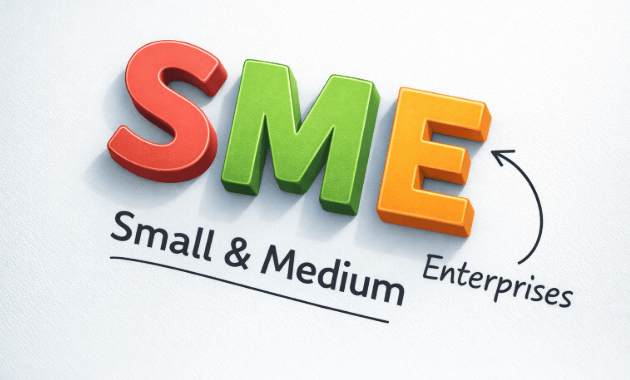
In the UK, SME stands for Small and Medium-sized Enterprise. Put simply, an SME is a business that isn’t a large corporation – most everyday companies you deal with fall into this category.
The official guidance most often used by the UK government says an SME is a business that:
- Has fewer than 250 employees.
- Has turnover under around £44 million or a similar level of total assets (balance sheet).
What does SME stand for and what is an sme in business terms?
In other words, if your business employs fewer than 250 people and your figures are below those limits, it’s almost certainly an SME. That includes limited companies, partnerships, and even many sole traders.
So when you’re searching SME meaning or asking what is an sme, in most UK contexts, it’s this broad, practical definition that applies.
What is the official SME definition in the UK and how is it used?
The UK broadly follows the EU definition of small and medium-sized enterprises, which is still widely used in government schemes and statistical reports. Under that framework, small and medium-sized enterprises (SMEs) are businesses that:
- Employ fewer than 250 people.
- Have annual turnover up to €50 million or a balance sheet total up to €43 million.
UK guidance now often converts this into sterling and uses UK-specific figures (such as “under £44 million turnover”) to make it easier for you to apply.
This SME definition UK is used to decide whether your business can access:
- Certain grants and funding schemes
- Research and innovation support
- “SME-friendly” procurement opportunities
- Some forms of tax relief or lighter regulations.
How is an SME different from a large company in the UK?
A large company will typically have:
- 250 or more employees
- A much higher level of turnover and assets than the SME thresholds allow.
The practical difference for you is that SMEs often get special treatment – in a good way. Smaller businesses may:
- Face simpler reporting requirements,
- Get priority access to some support programmes, and
- Benefit from targeted funding and advisory schemes.
Understanding whether you’re an SME is the first step to making sure you’re using all of that to your advantage.
How Do UK Rules Define a Small and Medium-Sized Enterprise?

What are the key SME criteria – staff, turnover and assets?
When you try to work out what is an sme business, three numbers matter most:
- Headcount – how many people work in the business.
- Annual turnover – how much income the business brings in over a year.
- Balance sheet total – the total value of the business’s assets.
For most SME-focused schemes, you must have:
- Fewer than 250 employees.
- Turnover and/or balance sheet totals under the SME thresholds (for UK guidance, often “under £44m turnover or under £38m balance sheet total”).
For UK company law and statutory accounts, slightly different thresholds are used to decide whether you are a small or medium company under the Companies Act. For example, a “small company” is usually one that meets two of these three tests:
- Turnover not more than £10.2 million.
- Balance sheet total not more than £5.1 million.
- 50 or fewer employees.
These “small company” thresholds affect your reporting and filing obligations, which is why they’re often mentioned alongside the broader SME concept.
How do micro, small and medium enterprises break down?
To make things clearer, SMEs are split into three size bands. The EU breakdown (still widely referenced in the UK) looks like this:
| Category | Employees (fewer than…) | Turnover (max) | Balance sheet total (max) |
|---|---|---|---|
| Micro enterprise | 10 | €2 million | €2 million |
| Small enterprise | 50 | €10 million | €10 million |
| Medium enterprise | 250 | €50 million | €43 million |
If your UK business fits any of these categories, you’re counted as part of the SME population.
Why Does Your SME Status Matter in Practice?
How does SME status affect tax, reporting and regulation?
When you know your business meets the SME criteria, you can often:
- Qualify for simpler accounts and filing requirements as a small company if you meet the Companies Act thresholds.
- Access certain R&D tax reliefs, innovation grants and regional funding.
- Be treated differently in areas such as public procurement and regulatory consultations, where governments want to make sure SMEs are not pushed out by large corporates.
Your SME status doesn’t change your core obligations like paying the correct tax, meeting employment law or following health & safety rules. It simply means that in some areas you get lighter rules, more support or extra protections.
What support and schemes are aimed at SMEs?
Because SMEs are seen as the engine of the UK economy, there are a range of support options specifically designed around them:
- Productivity and management programmes like Help to Grow: Management are aimed at businesses with 5–249 employees.
- Grant schemes and loan guarantees that set eligibility criteria around the EU/UK SME definition.
- Local and regional growth hubs, mentoring and export support, which usually target small and medium enterprises rather than large corporates.
If you don’t realise you’re an SME, you might not even think to look for this support, which is why understanding what is an sme company is more than just a technical detail.
How Can You Tell If Your Business Counts as an SME?
What simple steps show whether you’re an SME?
Here’s a quick way to check your SME status using your latest full-year figures:
- Count your employees
- Include full-time and part-time staff, and adjust for part-timers where required.
- Check your annual turnover
- Use the figure from your profit and loss statement for the most recent financial year.
- Check your balance sheet total
- Look at the total assets figure on your balance sheet.
- Compare against SME thresholds
- If you have fewer than 250 employees and your turnover and assets are below the SME limits (e.g. under the £44m/€50m guidance), you’re an SME. ˀ
- Check if you’re also a “small company”
- If you meet at least two of the small company tests (turnover, balance sheet, employees), you may qualify for simpler accounts and some filing exemptions.
If you sit very close to the thresholds, it’s worth getting advice from your accountant so you’re using the correct category for your filings and any applications you make.
What if your figures change year to year?
Your business isn’t frozen in one size band forever. Over time, your SME status can move:
- If you grow staff and turnover, you might move from micro to small, or small to medium.
- If you shrink – for example, after a restructuring, you might move down a category.
In most regulatory and support schemes, reclassification doesn’t happen on a single good or bad year. Often you need to be over or under the threshold for two consecutive years before your “official” company size changes.
What Are Some Common Examples of SMEs in the UK?
Which kinds of businesses are usually SMEs?
SMEs are everywhere in the UK. According to recent government figures, small and medium-sized enterprises make up around 99% of UK businesses, employing about 60% of the workforce and generating over half of private sector turnover.
Here are some everyday examples and how they might sit within the SME bands:
| Example business type | Likely size band | Typical employee range |
|---|---|---|
| One-person graphic design studio | Micro enterprise | 1–2 |
| Independent café or barbershop | Micro / Small | 3–15 |
| Local accountancy or law firm | Small enterprise | 10–40 |
| Regional construction contractor | Small / Medium | 20–150 |
| Niche manufacturing company | Medium enterprise | 50–230 |
All of these are SMEs for most practical purposes – even though their scale and needs can look quite different.
Are sole traders and freelancers classed as SMEs?
Yes. When UK statistics talk about SMEs, they normally include:
- Sole traders and self-employed people.
- Partnerships.
- Limited companies.
So if you’re a freelancer, contractor or one-person consultancy, you’re still part of the SME population, usually in the micro-enterprise category.
It’s also worth staying informed about wider policy changes that could indirectly affect your business, for example, updates to the New PIP Rules in the UK may influence financial planning or benefit eligibility for self-employed individuals.
What Advantages and Challenges Do SMEs Face in the UK?
What advantages do SMEs have over large corporations?
Being smaller can actually give you an edge. Small and medium enterprises can often:
- Respond faster – you can make decisions quickly without layers of approval.
- Offer a more personal service – customers value dealing directly with the owner or a small team.
- Innovate in niche markets – you can specialise in areas that are too small or too complex for big corporates to bother with.
- Adopt new tech quickly – cloud tools and AI services are increasingly affordable, helping you compete with much larger firms.
When you understand what does sme mean in this practical sense, you can start leaning into these strengths instead of comparing yourself directly to big brands.
What challenges do SMEs typically face in the UK?
Of course, SMEs also face some consistent headaches. Reports on business health in the UK highlight that smaller firms can be more vulnerable to economic shocks, rising costs and late payments.
Common challenges include:
- Access to finance – securing loans or investment on good terms.
- Cash flow pressure – especially from late-paying customers.
- Compliance and admin – staying on top of tax, HR, and regulatory changes with a small team.
- Skills gaps – finding and affording people with digital, technical or leadership skills.
- Time – you’re often doing sales, operations, finance and strategy at once.
Recognising these patterns can help you look for SME-specific support, peer networks and tools that directly target these pain points.
SME vs Startup vs “Small Business”: What’s the Difference?
Is every startup an SME – and is every SME a startup?
Most startups in the UK start life as SMEs – usually as a micro or small enterprise. They sit comfortably within the definition of SME in business while they are still building their product, finding customers and experimenting with their model.
However:
- A startup is about stage and ambition, high growth, innovation, and often external investment.
- An SME is about size, employee numbers, turnover and assets.
You can have:
- A mature 20-year-old SME that is not a startup at all.
- A high-growth startup that is technically an SME but has very different goals to a traditional small business.
What’s the difference between an SME and a “small business”?
In everyday speech, people use “SME” and “small business” almost interchangeably. But there are differences:
- A small business is usually thought of as having fewer than 50 employees, and in UK law, “small company” has specific turnover and balance sheet limits.
- An SME covers micro, small and medium enterprises, up to 249 employees.
So all small businesses are SMEs, but not all SMEs are small businesses. A company with 200 staff is clearly an SME, but most people wouldn’t describe it as “small”.
What Should You Do Next If Your Business Is an SME?
Are you using your SME status to your advantage?
Once you’ve worked out where you sit in the SME bands, you can start asking some smart questions:
- Are you taking full advantage of SME-only grants, loan schemes or tax reliefs you might be eligible for?
- Are you preparing accounts and filings in the most efficient way allowed for your size?
- Are you using tools (like cloud software and AI) that help small and medium-sized enterprises punch above their weight, rather than copying enterprise-level systems that don’t fit your scale?
How can you turn this knowledge into a growth plan?
Understanding what is an sme isn’t just about ticking a box. It’s about seeing your business clearly: how big it really is, what support it can access, and what advantages you naturally have as a smaller organisation.
By knowing your SME meaning in the UK context, you can:
- make better decisions on funding,
- target the right customers and contracts, and
- build a realistic plan to move from micro to small, or small to medium – if that’s what you want.
Conclusion: Why your answer to “what is an SME?” matters
To sum up:
- An SME in the UK is broadly any business with fewer than 250 employees and turnover under the SME thresholds, often taken as around £44m.
- SMEs cover micro, small and medium enterprises, from one-person consultancies to regional manufacturers.
- Your SME status affects what support, rules, and opportunities apply to you – and it can highlight strengths that large companies simply don’t have.
Once you’re clear on what is an sme for your own situation, you’re in a much stronger position to use the UK’s SME-focused ecosystem to grow, adapt and thrive.