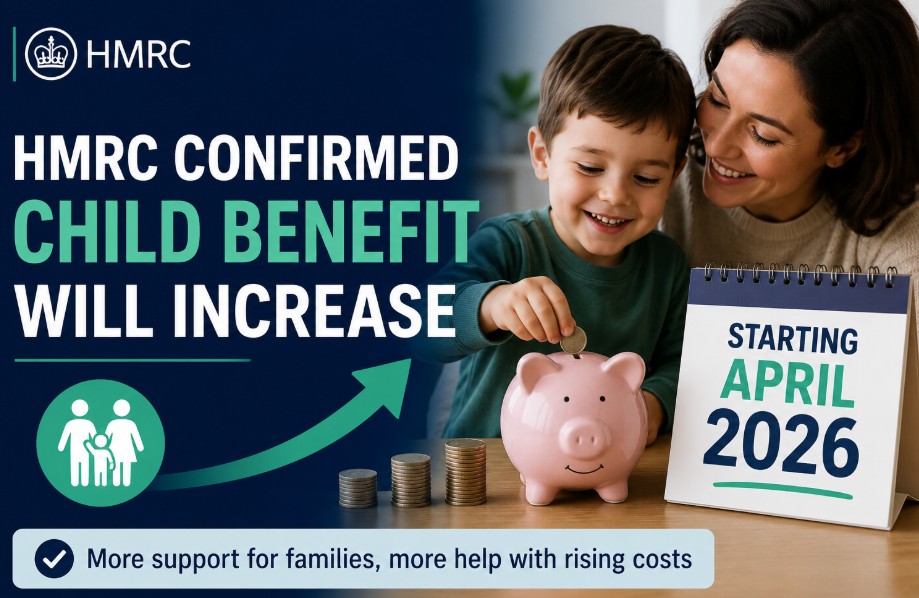
HMRC Confirmed Child Benefit Will Increase Starting April 2026
Yes, His Majesty’s Revenue and Customs HMRC confirmed Child Benefit will increase starting April 2026 to help families balance their household budgets against persistent cost-of-living pressures.
This statutory uprating applies across the United Kingdom, adjusting the weekly payment rates for families with dependent children to match the 3.8% Consumer Price Index (CPI) inflation benchmark from the preceding autumn.
What Is Child Benefit?
Child Benefit is a tax-free, non-means-tested weekly payment available to anyone responsible for a child under 16, or under 20 if they remain in approved full-time education or training.
Child Benefit is a core element of the UK welfare system designed to assist families with the general costs of bringing up a child. You do not need to be in work or have savings to be eligible; it is available to parents, guardians, adoptive parents, and those with informal care arrangements.
Has HMRC Confirmed a Child Benefit Increase Starting April 2026?
Yes, the UK government confirmed an automatic uplift for millions of households to ensure support keeps pace with the 3.8% Consumer Price Index (CPI) inflation benchmark.
HMRC has officially verified that qualifying households across the UK will receive an automatic increase in their welfare allowances. This adjustment is part of the annual social security review, designed to help families manage household budgets against ongoing cost-of-living pressures.
Legislative Underpinnings of the 2026 Rate Uplift
The increase is mandated by the Social Security Administration Act 1992, which requires an annual review of benefits to maintain their value against inflation.
The legal basis for this change lies in the Social Security Administration Act 1992, which obligates the government to review state benefits annually. By linking the uplift to September CPI data, the state preserves the purchasing power of the allowance.
Importantly, this process is automated; parents with active claims do not need to take any manual action to receive the higher rate.

What is the HMRC Confirmed Child Benefit Increase?
The increase is a statutory annual up-rating of 3.8% based on the Consumer Price Index (CPI) from the preceding autumn, ensuring benefits maintain their purchasing power.
This adjustment represents a mandatory review of welfare allowances. For the 2026/27 tax year, the government increased the weekly rate by £1.00 for the first child and £0.65 for each additional child.
This is not a policy change but a routine financial preservation measure carried out by the Treasury to align benefits with the rising cost of living.
Who Benefits From the Increase?
Every household with an active, verified Child Benefit claim automatically benefits from the 3.8% up-rating, regardless of their employment status.
The increase applies to all families currently receiving the benefit. Even if your household income is high and you are subject to the High Income Child Benefit Charge (HICBC), the gross benefit amount you receive (or qualify for) has increased, ensuring the support value remains aligned with inflation.
What is the Official HMRC Confirmed Child Benefit Increase Starting April 2026 Date?
The updated Child Benefit rates took effect on 6 April 2026, which marks the first day of the 2026/27 tax year.
The structural adjustments to the UK welfare framework do not happen overnight; they align precisely with the boundary lines of the fiscal calendar.
The Phased Payment Transition
Your first payment after 6 April 2026 will be a blended amount, reflecting the old rate for days before the change and the new rate for days after.
Because Child Benefit is paid in recurring cycles, your first disbursement following 6 April will reflect a split rate. To track your specific payment timeline:
To track your specific distribution timeline without waiting for postal correspondence, follow these operational steps:
- Download or log into the official HMRC app using your secure Government Gateway credentials.
- Navigate to the Check payments section within the primary navigation dashboard.
- Review the upcoming disbursement date scheduled for April 2026.
- Verify if your account is set up for weekly or 4-weekly distribution intervals.
- Review the payment breakdown to observe the blended rate applied to days falling after 6 April.
- Confirm that your bank details remain accurate to prevent temporary administrative processing holds.

How Much Is Child Benefit UK 2026 Per Month?
Calculating household income accurately requires looking at the figures beyond weekly amounts, especially since most household utility bills and mortgage obligations operate on a monthly cycle.
HMRC evaluates Child Benefit using a multi-tiered system that distinguishes between the eldest or only child and any subsequent children in the household.
| Child Category | Weekly Rate (Old) | New Weekly Rate (2026/27) | 4-Weekly Payment (Per Month) | Total Annual Value |
| Eldest or Only Child | £26.05 | £27.05 | £108.20 | £1,406.60 |
| Additional Children | £17.25 | £17.90 | £71.60 | £930.80 |
Monthly Cash Flow Projections for Households
As shown above, an only child yields a stable monthly sum of £108.20, paid every four weeks directly into a designated current account.
When you’re sorting out your monthly budget, it is worth remembering that HMRC counts a ‘month’ as a standard four-week period. Because of this, you’ll actually receive 13 payments over the course of a year rather than 12.
What is the Total Child Benefit From April 2026 for 2 Children?
For a standard multi-child household, the combined income streams create a more substantial safety net. When calculating child benefit from April 2026 for 2 children, the award combines the primary higher rate for the firstborn child with the secondary rate for the next child.
Combined Weekly Calculation: £27.05 + £17.90 = £44.95 per week
Multi-Child Allowance Breakdown
When scaled across the standard financial milestones, a family holding valid claims for two children receives an aggregate payment of £179.80 every four weeks. Over twelve months, this amounts to a cumulative total of £2,337.40 in state support.
Consider the typical scenario of Sarah, an independent graphic designer running a small consultancy, the incoming monthly sum covers essential grocery price increases without disrupting her core business cash reserves or dividend drawdown strategy.
Will I Get Paid for My 3rd Child in 2026?
A significant amount of confusion stems from overlapping policy names within the UK welfare ecosystem, leading many parents to believe they are capped after two children.
It is essential to understand that the well-known two-child limit applies strictly to Universal Credit and Child Tax Credits, whereas Child Benefit remains completely uncapped.
| Benefit System | Applied Policy Limit | Operational Impact on 3rd Child |
| Universal Credit | Two-Child Cap Enforced | No additional element paid for third child born after April 2017 |
| Child Benefit | Universal Universal Allowance | Full statutory rate of £17.90 per week paid for every additional child |
Uncapped Eligibility Rules Explained
You will receive a dedicated allowance for your third child, as long as they meet the standard criteria of being under 16, or under 20 if they stay in approved full-time education or training. Adding a third child to your claim brings the family’s weekly allowance to £62.85, which equals £251.40 every four weeks.
What Is the Maximum Income to Qualify for Child Benefit?
While Child Benefit is theoretically universal, high earners must navigate the High Income Child Benefit Charge (HICBC). If an individual parent or guardian’s Adjusted Net Income exceeds £60,000, they face a tax charge designed to gradually claw back the value of the benefit.
Strategic Implications for Small Business Owners
The clawback operates via a 1% tax charge for every £200 of income earned above the £60,000 threshold. Once an individual’s income hits £80,000, the tax charge equals the full value of the Child Benefit received, effectively reducing the net support to zero.
If you’re a company director or self-employed, keeping an eye on this threshold is just as important as the rest of your tax planning. For example, David owns a small digital agency and expects his income to reach £64,000.
To protect his family’s allowance from the HICBC taper, he chooses to allocate £4,000 into his workplace pension via a legitimate salary sacrifice arrangement.
This keeps his Adjusted Net Income at exactly £60,000, preserving his full benefit entitlement while lowering his overall corporation and personal tax exposure.

How Do I Manage My HMRC Confirmed Child Benefit Online?
The days of dealing with long paper application forms and waiting weeks for a response are largely gone. HMRC has moved its core services online, making it much easier to submit claims and update your personal information quickly.
- Rapid Processing Times: Submitting a digital application via the official online portal takes roughly ten minutes and can be done just 48 hours after registering a birth.
- Direct Payment Tracking: The online portal allows users to instantly update banking details, report changes in a child’s education status, and view past payments.
- Backdating Protection: Legally, claims can only be backdated for a maximum of three months, so using digital submission helps avoid missing out on payments due to postal delays.
- National Insurance Protection: Claiming online secures vital National Insurance credits for a stay-at-home parent, protecting their entitlement to the UK State Pension later in life.
What Should Families Do Now?
No manual action is required to receive the new rates; however, families should log into their Government Gateway account to ensure their personal details, bank information, and education status records are up to date.
To stay ahead, take these proactive steps:
- Verify Details: Log in to the HMRC app to confirm your address and bank details are accurate to avoid payment holds.
- Check Education Status: If your child has turned 16, ensure you have used the online portal to confirm they remain in approved education or training to prevent automatic payment cessation.
- Review Income: If you are nearing the £60,000 HICBC threshold, evaluate if you should adjust your pension contributions to maintain your eligibility.
Summary of Next Steps for UK Households
As the financial year shifts, keeping on top of your household finances means taking a few proactive steps:
- Log into your Government Gateway account to confirm your current personal details and payment schedule are up to date.
- Review your projected income for the year against the £60,000 High Income Child Benefit Charge threshold to see if you might face a tax charge.
- Look into tax-efficient ways to manage your income, like topping up your pension, which can help keep your adjusted net income below those tax thresholds if it makes sense for your situation.
- If you have a newborn, submit your claim online within the first three months to make sure you don’t lose out due to the backdating rules.
FAQ
Do I need to reapply to receive the higher rate starting April 2026?
No manual reapplication is required. The system automatically applies the 3.8% up-rating to all active, verified claims on the system, transferring the updated amounts into your account on your usual payment date.
Can I manage my claim entirely through a smartphone?
Yes. The app provides a direct way to view payment histories, change your address, report a child’s continuing education past 16, and download official proof of entitlement without needing to call.
Does claiming Child Benefit affect my future State Pension eligibility?
Yes, it can play a key role. If you stay at home to care for a child under 12 and do not earn enough to pay National Insurance, the claim automatically awards you National Insurance credits to protect your future State Pension.
What happens to my payments if my child turns 16?
Payments continue normally until the 31st of August following their 16th birthday. To extend payments up to their 20th birthday, you must use the online portal to confirm they are staying in approved full-time education or unpaid training.
Can separated parents both claim for the same child?
No, HMRC regulations state that only one person can receive Child Benefit for a specific child. If parents cannot agree on who should claim, HMRC will step in to review the living arrangements and make a final decision.
Is there a limit on how many children I can claim for?
There is no upper limit on how many children you can claim for under the Child Benefit system. The strict two-child limit applies only to separate welfare systems like Universal Credit.