
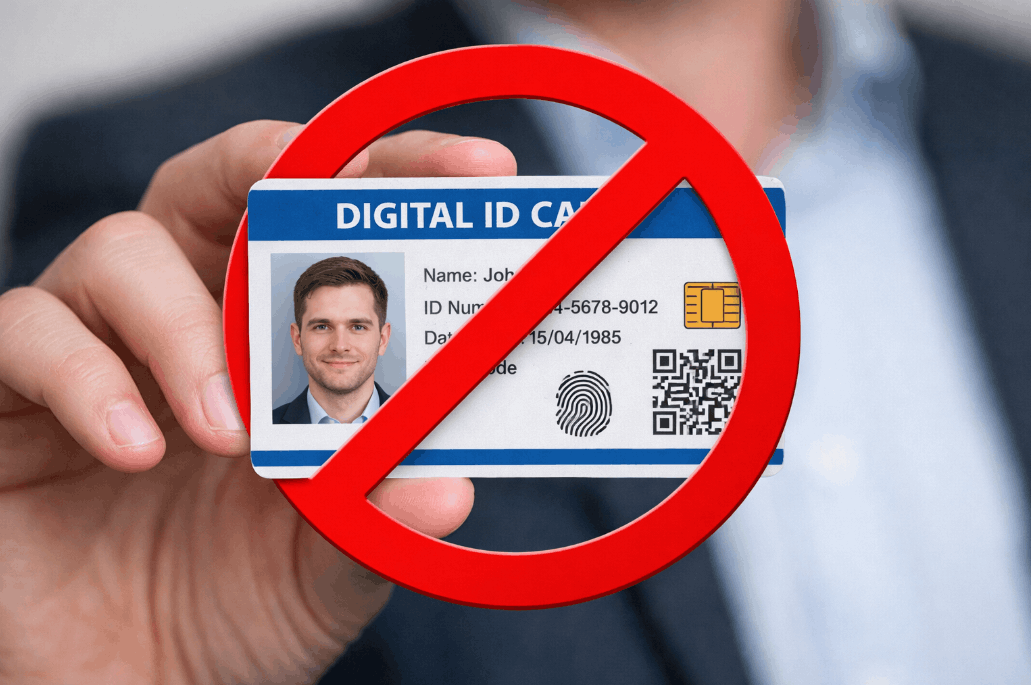
2026 Guide: Why Experts Say Do Not Introduce Digital ID Cards
The ongoing campaign against the introduction of digital ID cards in the United Kingdom reached a significant milestone in early 2026 as public petitions surpassed three million signatures.
While the government maintains that the Digital Identity and Attributes Trust Framework (DIATF) is a voluntary infrastructure, critics argue that the system creates a digital backdoor for mandatory surveillance and identity tracking.
As of 2026, the UK government has confirmed that there is no legal requirement for citizens to hold a digital identity card. Participation in the GOV.UK One Login and other digital wallet schemes remain strictly voluntary.
Citizens retain the legal right to use physical documents, such as passports or driving licences, for identity verification across all public and private sector services.
The core arguments against a national digital ID system
The core reason to do not introduce digital ID cards is the preservation of the historic right to anonymity in the UK.
Unlike a physical card, a digital ID creates a permanent, timestamped audit trail of every time a person verifies their identity.
This data centralisation creates a significant security risk, often referred to as a honeypot for cyber-criminals and state-sponsored hackers.
The Erosion of Personal Sovereignty
Beyond simple data breaches, the shift toward a programmable identity is what concerns privacy advocates most.
Having monitored the rollout of various state-led IT projects over the last decade, I have observed that the transition from optional to de facto mandatory occurs when manual, physical verification is made intentionally difficult.
When a system is digital-by-default, those who choose to opt out often face administrative friction that limits their access to the economy.
This friction is already visible in other sectors where automated oversight is expanding. This friction is already visible in other areas of state oversight.
For instance, the recent discourse surrounding the DWP pension bank rules update reflects a broader public unease regarding the extent of government access to private financial data.

Is the new digital ID UK mandatory in 2026?
No, the new digital identity framework is not mandatory. The 2026 Government Consultation explicitly states that physical documentation remains a valid alternative.
However, the rise of digital-only processes in the private sector has led many to believe a mandate is already in place.
- Verify the Source: Always check if the request for digital ID is coming from a statutory body or a private Identity Service Provider (IDSP).
- Request Manual Check: Inform the service provider that you wish to use the physical document verification route under current Home Office guidance.
- Generate a Share Code: If required for work, use the Gov UK sharing code system for specific, one-time proof of status.
- Audit Your Data: Regularly check the privacy settings on your GOV.UK One Login if you have previously registered.
- Support Legislative Oversight: Follow the progress of the Data Protection and Digital Information Bill through Parliament.
- Join the Debate: Participate in local and national do not introduce digital ID cards debate forums to stay informed on policy shifts.
- Contact Your MP: Use your democratic right to express concerns about the long-term impact of the DIATF on civil liberties.
Distinguishing Verification from Identity
A common pattern I see is the confusion between proving a specific attribute (like being over 18) and revealing a full identity. A digital ID often reveals more data than necessary.
For example, a shop only needs to know you are of legal age, not your full name, home address, and date of birth. Physical cards allow you to cover irrelevant information with your thumb; digital systems often share a full data packet automatically.

Understanding the impact of the digital ID petition UK
The national petition against digital ID cards has become one of the most successful civil actions in British history.
This widespread movement was a direct response to the BritCard proposal of 2025, which forced a parliamentary debate and a subsequent government U-turn.
| Feature | Physical ID Verification | Digital Identity (DIATF) |
| User Privacy | High (no digital footprint) | Low (tracked transactions) |
| Accessibility | Works for all (no tech needed) | Excludes 10% of smartphone-free adults |
| Security Risk | Single document loss | Systemic mass data breach |
| Government Control | Distributed and decentralised | Centralised and revocable |
| Verification Speed | Immediate (human to human) | Instant (algorithmic) |
Can I refuse a digital ID in the UK?
You can legally refuse to use a digital ID in the UK for almost all transactions. Whether you are opening a bank account, renting a property, or starting a new job, the service provider is required to offer a non-digital alternative.
Navigating these requirements can be particularly stressful for small business owners who are already balancing multiple regulatory shifts. For many firms, the move toward digital-only verification represents a daunting regulatory shift.
Similar to the logistical hurdles seen with the UK minimum wage rise concerns, the administrative burden of these new identity checks often falls on small business owners who lack the infrastructure for complex manual overrides.
If a business claims they can only accept a digital check, they may be in breach of the Equality Act 2010 regarding digital exclusion.
When reviewing decisions made by HR departments, I found an anonymised case where a candidate in London was told they must use a specific smartphone app to start their job.
By citing the official Home Office Employer: Right to Work Checks guidance, the candidate successfully forced a manual passport check, proving that the legal right to opt out remains enforceable if the citizen is persistent.
Why are people against digital IDs?
The opposition is rooted in four primary concerns: function creep, cybersecurity, exclusion, and state overreach.
The petition against digital ID movements highlights that once the infrastructure exists, it is very easy for a government to add new requirements, such as linking ID to travel rights or social media access.
- Function Creep: A tool for Right to Work today could become a tool for Social Credit tomorrow.
- The Honeypot Effect: Centralised databases of biometric data are prime targets for international hacking syndicates.
- Identity Mobile Vulnerabilities: Relying on a smartphone for identity means that a dead battery or a lost phone results in a total loss of civil access.
How the GOV UK sharing code works in practice
The GOV UK sharing code is the current method for verifying status without a physical card. It is a one-time-use alphanumeric string that allows a third party (like a landlord or employer) to view a specific subset of your data for a limited time (usually 30 days).
While more secure than a permanent ID number, the sharing code still requires the citizen to engage with the digital database. For those who strictly believe we should do not introduce digital ID cards, even the sharing code is seen as a step toward a total digital state.
In practice, many citizens use these codes for the speed they offer while simultaneously supporting the ID card petition to ensure physical documents are never phased out entirely.
What do recent public polls reveal about digital identity?
Recent do not introduce digital ID cards poll data from 2026 suggests that while 60% of people appreciate the convenience of digital services, over 80% are very concerned about the lack of a physical-only option.
This tension is what fuels the do not introduce digital ID cards government petition year after year.
| Concern Level | Topic | Public Sentiment (2026) |
| 92% | Mandatory Requirement | Overwhelmingly Opposed |
| 78% | Data Sharing with Private Firms | Highly Concerned |
| 65% | Cybersecurity Risks | Concerned |
| 54% | Convenience of Digital Wallets | Neutral to Positive |
Can shops legally take your ID?
In the UK, shops can ask to see your ID to verify your age, but they have no legal right to take or scan your ID into a private database without your explicit consent. Many retailers are moving toward digital age-verification tools.
If you use these, you are essentially creating a digital ID profile with a third-party company. You always have the right to show a physical driving licence or PASS-accredited card instead.
FAQ about Do Not Introduce Digital ID Cards
Is the UK petition against digital ID cards still active?
Yes, multiple petitions remain active on the official Parliament website. These petitions frequently reach the 100,000-signature threshold required for a parliamentary debate on the future of the DIATF.
Will digital ID be mandatory in UK for voting?
No. The Voter ID laws introduced in 2023 allow for a wide range of physical photo IDs. While some digital options may be trialled, they are not a mandatory replacement for physical cards.
How do I get a GOV UK sharing code?
You can generate a code by logging into the View and Prove section of the GOV.UK website. You will need your document number (passport/BRP) to access the system.
What is the new digital ID UK called?
The official framework is the Digital Identity & Attributes Trust Framework (DIATF). It is often marketed to the public through the GOV.UK One Login service.
Can I opt out of the digital ID database?
You can choose not to register for the GOV.UK One Login. However, if you have already registered, you can request that your account be deleted, though some statutory records remain as required by law.
What is the primary cause of the digital ID cards debate?
The debate exists because of the fundamental conflict between administrative efficiency and the right to privacy. Critics argue that the risks to civil liberties far outweigh the convenience of digital checks.
Is Identity Mobile a government app?
No. Identity Mobile usually refers to private telecommunications or mobile-based ID providers. Government services are typically accessed through the official GOV.UK app or website portals.
Final Summary and Next Steps
The landscape of identity in 2026 remains a battleground between convenience and privacy. While the government continues to build the infrastructure for a digital state, the legal right to do not introduce digital ID cards is currently protected by public resistance and parliamentary oversight.
Maintaining this oversight is essential for preserving the long-standing social contract. Just as the consistency of the pension triple lock acts as a measure of government reliability, the commitment to keeping digital IDs strictly voluntary must be upheld to maintain public trust.
To safeguard your rights, you should proactively request manual verification for employment and housing, participate in active government consultations, and support legislative transparency.
The most effective way to prevent a mandatory system is to ensure the voluntary alternatives remain robust, accessible, and free from administrative penalties.