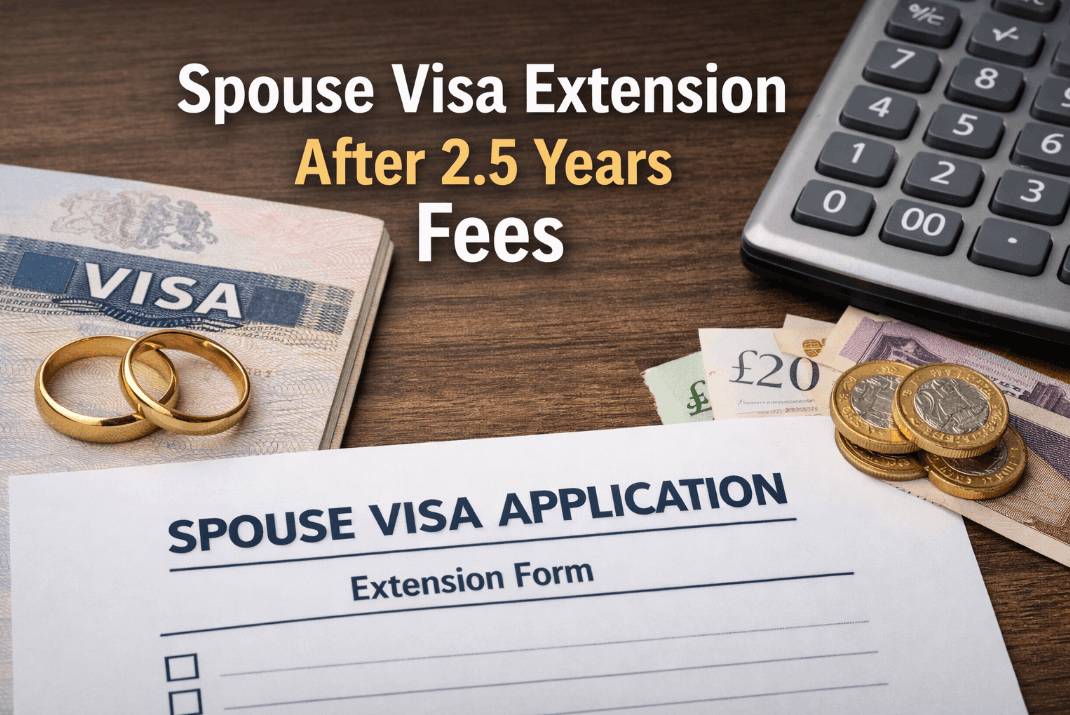
Spouse Visa Extension After 2.5 Years Fees: 2026 Guide On IHS Costs and Financial Rules
Spouse Visa Extension After 2.5 Years Fees are a minimum of £4,013.70 per applicant in 2026: a £1,407 Home Office application fee, £2,587.50 Immigration Health Surcharge, and a £19.20 biometric fee. Only the £1,000 Super Priority service is available for a faster decision, the £500 five-day Priority option is not currently offered for in-country FLR(M) applications.
Key takeaways
- The FLR(M) application fee rose from £1,321 to £1,407 on 8 April 2026, and it is never refunded even if the application is refused.
- For in-country FLR(M) extensions, only the £1,000 Super Priority service is available; the £500 five-day Priority option is not currently offered.
- Applicants who first applied before 11 April 2024 keep the lower £18,600 income threshold, while later applicants must meet the £29,000 rule.
- A consultation to extend the ILR qualifying period from 5 to 10 years closed in February 2026, with no rule change confirmed yet.
How Much is the Spouse Visa Extension Fee After 2.5 Years?
The total cost of your extension is split into two primary mandatory payments: the Application Fee and the Immigration Health Surcharge (IHS).
For an application made from inside the UK (which is the case for almost everyone extending after 2.5 years), the fees for 2026 are:
Home Office Application Fee
The FLR(M) application fee is £1,407, following the Home Office’s fee increase on 8 April 2026 (up from £1,321). This fee is non-refundable regardless of the outcome. even a straightforward refusal does not entitle you to any money back, which is why getting the documentation right the first time matters more than the fee amount itself.
Immigration Health Surcharge (IHS)
The IHS rate has been frozen at £1,035 per year since 6 February 2024, so unlike the application fee, it hasn’t moved for this year’s extensions. For a standard 30-month (2.5-year) extension, the cost is £2,587.50, paid in full and upfront when you submit your application.
Total Mandatory Budget for 2026
| Fee Category | Cost per Applicant |
|---|---|
| Home Office Application Fee (from 8 April 2026) | £1,407.00 |
| Immigration Health Surcharge (IHS) | £2,587.50 |
| Biometric Enrolment Fee | £19.20 |
| Total Minimum Cost | £4,013.70 |
Note: If you are applying with dependent children, you must pay the application fee and the IHS for each child. The IHS for children is slightly lower at £776 per year (£1,940 for the 30-month duration).
This rise is part of a broader pattern across Home Office and wider government services this year, and it’s worth budgeting for other renewals in the same window, since UK Passport Application Fees Increase too, so a family renewing several documents at once can end up facing more than one increase in the same year.

When Should You Apply for Your Spouse Visa Extension?
Timing is the most common area where applicants make mistakes. If you apply too late, you become an overstayer. If you apply too early, you may fall short of the 5-year residency requirement when you eventually apply for ILR.
- The 28-Day Rule: You should aim to submit your application within 28 days before your current leave expires. Note that physical BRP cards expired on 31 December 2024 and no longer show your true expiry date, check your actual leave expiry through your UKVI account (the digital eVisa record), not any date printed on an old card.
- 30 Months vs. 33 Months: If you entered the UK on an entry clearance visa, your initial visa was likely for 33 months. However, the extension grants you a further 30 months. To qualify for ILR after 5 years (60 months), you must ensure your total time spent in the UK on this route equals at least 60 months.
What are the Financial Requirements for Extension in 2026?
In April 2024, the UK government raised the minimum income requirement from £18,600 to £29,000. Further increases to £34,500 and then £38,700 were floated at the time but have since been paused while the Migration Advisory Committee reviews the policy, £29,000 remains the applicable threshold for new applicants as of 2026, with no confirmed date for any further rise.
Thresholds like this don’t sit in isolation either; anyone comparing routes across the wider immigration system will find the UK Visa Financial Requirements follow a similar pattern of transitional protection depending on when an applicant first entered a route, so it’s worth understanding how your own timeline lines up before assuming a figure applies to you.
The £18,600 Transitional Rule
If you successfully applied for your first spouse visa before 11 April 2024, you are protected. You only need to meet the old threshold of £18,600 for your extension and your future ILR application, as long as you are staying with the same partner.
The £29,000 New Threshold
If your first spouse visa was granted on or after 11 April 2024, you must prove a combined gross annual income of £29,000.
Meeting the Requirement via Savings
If you do not meet the income threshold through employment, you can use cash savings. For families finding these thresholds difficult to meet, some consider switching to skilled work routes; in such cases, identifying the list of companies that can sponsor visa in UK is a practical first step toward a different residency path.
However, the amounts required in 2026 are high:
- To meet the £29,000 requirement with savings alone: You need £88,500.
- To meet the £18,600 requirement with savings alone: You need £62,500.
Savings must have been held in a regulated bank account for at least 6 months prior to the application.

Could the Route to Settlement Change to 10 Years?
If you’re extending at the 2.5-year mark, you’re currently on the standard five-year route to Indefinite Leave to Remain. A Home Office consultation on earned settlement, which proposed extending the qualifying period for ILR from 5 to 10 years for people already in the UK, not just new applicants, closed on 12 February 2026 after receiving over 200,000 responses.
As of today, no change to the Immigration Rules has taken effect and the five-year route remains in force. The government has indicated that changes could begin from autumn 2026, and the consultation document proposed applying any new rules to people already in the UK on the current route, though it also asked whether transitional protection should be given to borderline cases. Nothing is confirmed either way.
This doesn’t affect the fees or process for your current extension application. But if you’re weighing up timing, for example, whether to apply for ILR the moment you hit five years rather than leaving any gap, it’s worth checking GOV.UK for the latest position before you plan too far ahead, since this is one of the more fluid parts of the current rules.
Do I Need a New English Language Test for the Extension?
Although your initial entry clearance likely required a Level A1 certificate, the 2.5-year extension necessitates a step up to Level A2 to demonstrate your progress.
- The Requirement: You must pass a Secure English Language Test (SELT) at CEFR Level A2.
- Exemptions: You do not need a new test if:
- You have a degree taught in English (verified by Ecctis).
- You are over 65 years old.
- You are a national of a majority English-speaking country (e.g., USA, Australia, Jamaica).
- You already passed a B1 level test during your first application (you can reuse a B1 certificate for the extension and ILR).
How Long Does the Spouse Visa Extension Take?
Standard processing for an in-country FLR(M) application usually takes 8 weeks. You maintain your right to reside and work under Section 3C leave while waiting for a decision, and you can easily verify this for an employer by generating a right to work share code online.
During this time, you must not travel outside the Common Travel Area (UK, Ireland, Isle of Man, and Channel Islands), or your application will be treated as withdrawn.
Can I get a faster decision?
If you need a decision urgently, the Home Office offers Premium Services for an additional fee:
- Priority Service (£500): A decision is typically reached within 5 working days.
- Super Priority Service (£1,000): A decision is usually reached by the end of the next working day.
Common Mistakes That Lead to Costly Refusals
- Gaps in Cohabitation Evidence: You must provide at least 6 items of correspondence (joint or addressed individually) from at least 3 different sources, spread evenly over the last 2 years.
- The 28-Day Financial Rule: All financial documents (payslips and bank statements) must be dated within 28 days of the date you submit the online application.
- Missing the IHS Payment: The application is not considered valid until both the fee and the IHS are paid.

Suitability Requirements and Refusal Grounds
Beyond the financial and relationship evidence, your extension is also assessed against separate suitability requirements. These catch out applicants who otherwise meet every other criterion.
- Unpaid NHS charges of £500 or more that have been notified to the Home Office count against you.
- Unspent criminal convictions, in the UK or overseas, can lead to refusal even where the relationship itself is genuine.
- Previous immigration breaches, including overstaying or use of false documents at any earlier stage, are cross-checked against your history at extension stage, not just your current application.
It’s also worth knowing the difference between a refused and an invalid application. A refusal means the Home Office considered your case and decided you didn’t meet the requirements.
An invalid application, for example, one where the fee payment failed or a mandatory step was missed, means your case was never substantively assessed at all, and the automatic protection that keeps you lawfully in the UK while a decision is pending does not apply.
Both outcomes lose you the fee, but an invalid application can leave you without lawful status even though you genuinely tried to apply on time.
Conclusion
Extending a spouse visa at the 2.5-year mark now costs just over £4,000 per applicant once the 8 April 2026 fee increase is factored in, and the process is a full reassessment rather than a formality.
Before you apply: confirm which financial threshold applies to you, set up (or check) your UKVI account rather than relying on an old BRP expiry date, book your A2 English test early if you need one, and be aware that only the £1,000 Super Priority service is currently available if you need a faster decision.
Keep an eye on GOV.UK for any confirmed movement on the proposed 10-year settlement route before you finalise your longer-term plans.
Disclaimer: This article is for informational guidance only and does not constitute formal legal or immigration advice. For tailored assistance with your application, please consult a qualified legal professional or check official guidelines on GOV.UK.
FAQ
How do I extend my UK spouse visa after 2.5 years?
You apply online for FLR(M) before your current leave expires, pay the application fee and IHS, then complete biometric enrolment through UKVCAS. Standard processing takes around 8 weeks from your biometrics appointment.
How much does it cost to extend my spouse visa in the UK?
The minimum mandatory cost in 2026 is £4,013.70 per applicant: £1,407 application fee, £2,587.50 IHS, and £19.20 for biometrics. Each dependant included in the application pays the same fees separately.
What is the 2-year rule for spouse visa?
This usually refers to unmarried partners, not married applicants. To qualify as a durable partner, you must show a relationship akin to marriage for at least 2 years, cohabitation helps but isn’t strictly required if you can explain why you lived apart.
How much is the spouse visa extension fee in the UK 2026?
The Home Office application fee is £1,407 from 8 April 2026, up from £1,321. This is separate from the £2,587.50 Immigration Health Surcharge, which is unchanged.
Do I need to set up a UKVI account before I extend my spouse visa?
Yes, if you haven’t already. Physical BRP cards expired at the end of 2024, so your current leave and any new grant are recorded digitally as an eVisa, accessed through a free UKVI account.
Will the ILR qualifying period increase from 5 to 10 years before I apply?
Not yet. A consultation on extending ILR to 10 years closed in February 2026, but no rule change has taken effect as of today. The five-year route still applies; check GOV.UK before you plan your ILR timing.
Can I rely on my own income if I’m not married but have lived with my partner for over two years?
Yes, in principle, unmarried partners are assessed under the same financial requirement as married applicants once the 2-year durable relationship test is met, and combined income from both partners is normally accepted for in-UK applications.