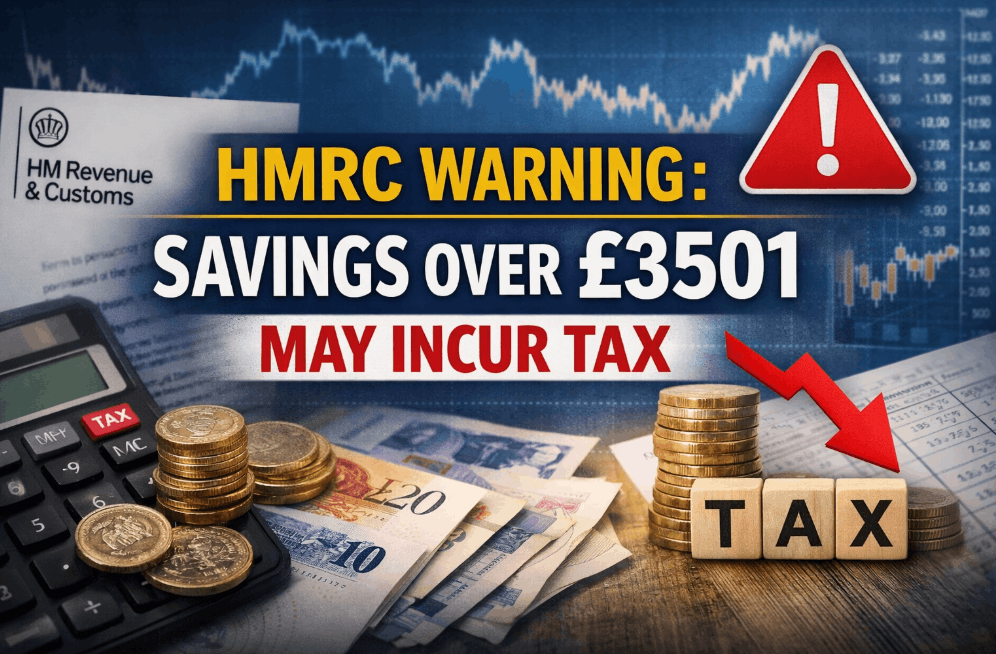
HMRC Warns That Savings Over £3,501 May Incur Tax: Is Your Money at Risk?
HMRC has not issued a specific £3,501 warning; that figure comes from an example of a fixed-rate account generating enough interest to breach a taxpayer’s Personal Savings Allowance. The real limits are your PSA (£1,000, £500 or £0, depending on income) and the £10,000 threshold for registering for Self Assessment.
Key takeaways
- Basic-rate taxpayers keep a £1,000 tax-free Personal Savings Allowance in 2026/27, while higher-rate taxpayers get £500 and additional-rate taxpayers get none.
- Savers must register for Self Assessment once total savings and investment income passes £10,000 in a tax year, even as a first-time filer.
- From 6 April 2027, income tax on savings interest rises by 2 percentage points to 22% basic, 42% higher and 47% additional rate, HMRC confirms.
- From 6 April 2027, under-65s can only shelter £12,000 of their £20,000 ISA allowance in cash, down from today’s unlimited £20,000 cash limit.
How does the HMRC warns that savings over £3501 may incur tax affect you?
£3,501 isn’t a threshold set by HMRC, it’s simply an amount that, at current fixed-rate savings rates, can tip a higher-rate taxpayer over their £500 allowance in one lump sum.
The underlying risk is real even if the number is illustrative: a higher-rate taxpayer with roughly £10,000 in a 5% easy-access account reaches their £500 limit within twelve months.
For basic-rate taxpayers the limit is double (£1,000), so the same easy-access account would need to hold closer to £20,000 before interest becomes taxable.
Fixed-rate bonds are the accounts most likely to catch people out, because the interest is often paid in a single sum on maturity rather than spread across tax years.
The mechanics of the 2026 savings tax landscape
The core issue is not the balance itself, but the interest crystallisation, the moment the bank credits interest to your account.
In practice, many savers forget that the Personal Savings Allowance (PSA) is tied to their income tax band.
If your total income from salary and interest pushes you into a higher bracket, your tax-free allowance for savings actually drops, creating a double-taxation effect that catches many off guard.
What does incurring tax mean and how does it affect your savings?
In simple terms, to incur tax means you have triggered a legal requirement to pay a portion of your earnings to the government because you have exceeded your tax-free allowances.
For savers, this happens the moment your total interest earned across all bank accounts, building societies, and peer-to-peer platforms goes over your Personal Savings Allowance (PSA).
The reality of incurring tax on interest is that it often happens behind the scenes. Most UK banks pay interest gross, meaning they no longer deduct tax before giving you your money.
It is therefore your responsibility, not the bank’s, to ensure the Revenue receives its cut. Many taxpayers naturally wonder, do I have to notify HMRC of savings interest especially if they haven’t been required to file a return in the past.
If you ignore this, the tax doesn’t disappear; it simply accumulates as a debt that HMRC will eventually collect, often with interest added.
| Taxpayer Band | Annual Income Range | Personal Savings Allowance (PSA) |
| Basic Rate (20%) | £12,571 to £50,270 | £1,000 |
| Higher Rate (40%) | £50,271 to £125,140 | £500 |
| Additional Rate (45%) | Over £125,140 | £0 |
What will be the penalty for savings over £3,501 that go undeclared?
If you exceed your allowance and do not ensure HMRC is aware, you face more than just the tax bill.HMRC has the power to issue late notification penalties and charge interest on the unpaid amount.
These strict compliance rules mirror other areas of taxation, such as when entrepreneurs must determine when do i need to register my business with HMRC to avoid similar fines for undeclared income.
When reviewing decisions made by HMRC, a common pattern is that penalties are often geared to the amount of tax owed, meaning the more you save, the higher the fine could be.
- Initial Late Filing Penalty: A flat £100 fine if you are required to send a Self Assessment and miss the deadline.
- Daily Penalties: After 3 months, HMRC can charge £10 per day for up to 90 days.
- Interest Charges: HMRC late payment interest is currently set at 7.75% (as of early 2026).
- Tax-Geared Penalties: After 6 months, an additional 5% of the tax due (or £300, whichever is greater).
- PAYE Underpayment: HMRC may recoup the tax by reducing your Personal Allowance next year, causing a drop in your monthly take-home pay.
- Deliberate Concealment: If HMRC believes you hid interest intentionally, penalties can reach 100% of the tax payable.
- Failure to Notify: If you earn over £10,000 in interest and fail to register for Self Assessment, specific non-disclosure penalties apply.
These penalty rules apply to standard Self Assessment. If you’re a sole trader or landlord with qualifying income over £50,000 who was brought into Making Tax Digital for Income Tax from April 2026, your submission penalties instead follow a separate points-based system, not the flat/daily/tax-geared structure above.
What’s changing for savers from 2026 and 2027?
The Autumn Budget 2025 introduced two changes that affect anyone weighing up where to hold their savings.
Dividend and savings tax rates are rising. From 6 April 2026, income tax on dividends rose by 2 percentage points (basic rate 8.75% to 10.75%, higher rate 33.75% to 35.75%).
From 6 April 2027, income tax on savings interest itself rises by the same 2 points, basic rate 20% to 22%, higher rate 40% to 42%, additional rate 45% to 47%. The Personal Savings Allowance and Starting Rate for Savings are unaffected, but interest above those allowances will be taxed more heavily from 2027 onward.
The Cash ISA allowance is being restructured. The overall £20,000 ISA allowance stays the same, but from 6 April 2027, savers under 65 will only be able to put £12,000 of it into a Cash ISA; the remaining £8,000 has to go into a Stocks & Shares ISA (or another non-cash ISA) to be used at all.
Savers aged 65 and over keep the full £20,000 Cash ISA allowance. The 2026/27 tax year is the last one in which under-65s can put the full £20,000 into cash tax-free.
| Change | Current (2026/27) | From April 2027 |
|---|---|---|
| Savings interest tax rate (basic/higher/additional) | 20% / 40% / 45% | 22% / 42% / 47% |
| Dividend tax rate (basic/higher) | 10.75% / 35.75% (from Apr 2026) | Unchanged |
| Cash ISA limit, under-65s | £20,000 | £12,000 (of the £20,000 total ISA allowance) |
| Cash ISA limit, 65 and over | £20,000 | £20,000 (unchanged) |
How to avoid incurring tax on savings over £3,501?
Avoiding the savings tax trap is perfectly legal if you use the right financial wrappers. A common mistake is leaving large sums in a high-interest current account while an ISA allowance remains unused.
For context, a higher-rate taxpayer who moves £10,000 into a Cash ISA could immediately shield their interest from a 40% tax grab.
- Move funds to a Cash ISA: You can deposit up to £20,000 per tax year into an ISA, where all interest is 100% tax-free and does not count toward your PSA.
- Invest in Premium Bonds: Prizes from NS&I Premium Bonds are tax-exempt. While there is no guaranteed interest, the winnings will never incur a tax bill.
- Utilise your spouse’s allowance: If your partner is in a lower tax bracket or has an unused PSA, moving savings into a joint account or their name can double your tax-free threshold.
- Contribution to Pensions: Increasing your pension contributions can lower your adjusted net income, potentially moving you from a 40% taxpayer back to a 20% taxpayer and doubling your PSA from £500 to £1,000.
Tips to avoid tax for savings over £3,501
To avoid the tax trap mentioned in recent HMRC warnings that savings over £3501 may incur tax, you must take a proactive approach to your finances.
Staying on top of your interest earnings is the only way to ensure you aren’t paying more than your fair share.
For example, if you’ve had tax deducted incorrectly via PAYE, you should confirm do HMRC automatically refund overpaid tax or if a manual claim is required to get your money back.
- Monitor Crystallisation Dates: If you have a fixed-term bond, ensure the interest isn’t all paid out in a single tax year, which could push you over the limit in one go.
- Check the Starting Rate for Savings: If your total earned income is less than £17,570, you may be eligible for an additional £5,000 tax-free savings interest.
- Use the Low-Coupon Gilt Strategy: For very large sums, some investors use UK Government Gilts. While the interest is taxable, the capital gains (the profit when you sell) are often tax-free.
| Savings Account Type | Tax Status | Impact on PSA |
| Standard Easy-Access | Taxable | Uses Allowance |
| Cash ISA | Tax-Free | No Impact |
| Premium Bonds | Tax-Free (Winnings) | No Impact |
| Fixed-Rate Bond | Taxable | Uses Allowance |
Why are more savers being caught by the HMRC threshold for taxable interest?
When examining HMRC’s enforcement trends, it becomes clear that penalties are typically tax-geared, meaning the higher the unpaid tax, the steeper the fine.
A saver might start the year with a balance below the danger zone, but a mid-year inheritance or a rate hike can push the annual interest paid well beyond their £500 or £1,000 limit.

How Does the HMRC Savings Tax Warning Impact Small and Business Owners?
Business owners must carefully monitor savings interest, as unexpected yields can inadvertently push total earnings into a higher tax bracket, trigger mandatory Self Assessment registration, and complicate cash flow forecasting.
- Director Income Structuring: Fluctuating interest can skew personal taxable income, unexpectedly reducing the Personal Savings Allowance from £1,000 to £500 or £0.
- Cash Flow Disruptions: Unanticipated tax bills on lump-sum interest create sudden, unbudgeted personal liabilities.
- Mandatory Compliance Triggers: Breaching the £10,000 savings and investment income threshold forces business owners into the Self Assessment system.
- Future Liquidity Planning: Upcoming 2027 tax hikes and Cash ISA restrictions require proactive long-term wealth management.
Conclusion
The £3,501 warning itself isn’t official, but the underlying pressure is real: higher rates mean modest savings balances can now generate enough interest to breach your Personal Savings Allowance, especially in fixed-rate accounts that pay interest in one lump sum.
Check your likely annual interest against your allowance (£1,000 basic-rate, £500 higher-rate, £0 additional-rate), and register for Self Assessment if your total savings and investment income will exceed £10,000.
If you’re not yet using your full £20,000 ISA allowance, 2026/27 is the last tax year you can shelter all of it in cash before the £12,000 cash cap begins for under-65s in April 2027.
FAQ
What is the HMRC warning to people with savings?
There isn’t an official HMRC warning targeting savings over £3,501 specifically. HMRC does write to individual savers whose bank-reported interest has exceeded their Personal Savings Allowance, but that’s routine tax collection, not a public warning.
How much savings can you have without paying tax in the UK?
There’s no cap on the balance itself. What’s taxed is the interest you earn above your Personal Savings Allowance (£1,000, £500 or £0 depending on your income tax band), at 5% interest, that’s roughly £20,000, £10,000 or £0 respectively before tax applies.
How do HMRC know if you have savings?
UK banks and building societies report interest paid to each customer directly to HMRC every year, automatically, whether or not you have a Self Assessment obligation. HMRC then matches this against your tax code or issues a bill.
What is the HMRC warning about savings of £3500?
The £3,500 figure isn’t an HMRC threshold. It comes from a worked example showing how a modest fixed-rate bond at current interest rates can generate over £500 interest, enough to exceed a higher-rate taxpayer’s allowance in one payment.
Will savings tax rates go up in 2026 or 2027?
Dividend tax rates rose from 6 April 2026. Income tax on savings interest itself is separate and rises by 2 percentage points across all bands from 6 April 2027, following the Autumn Budget 2025.
Is the £3,501 figure used anywhere official?
No. It doesn’t appear on GOV.UK or in HMRC guidance. It originated in financial media as an illustrative calculation and has since been repeated, without a source, across many similar articles.