
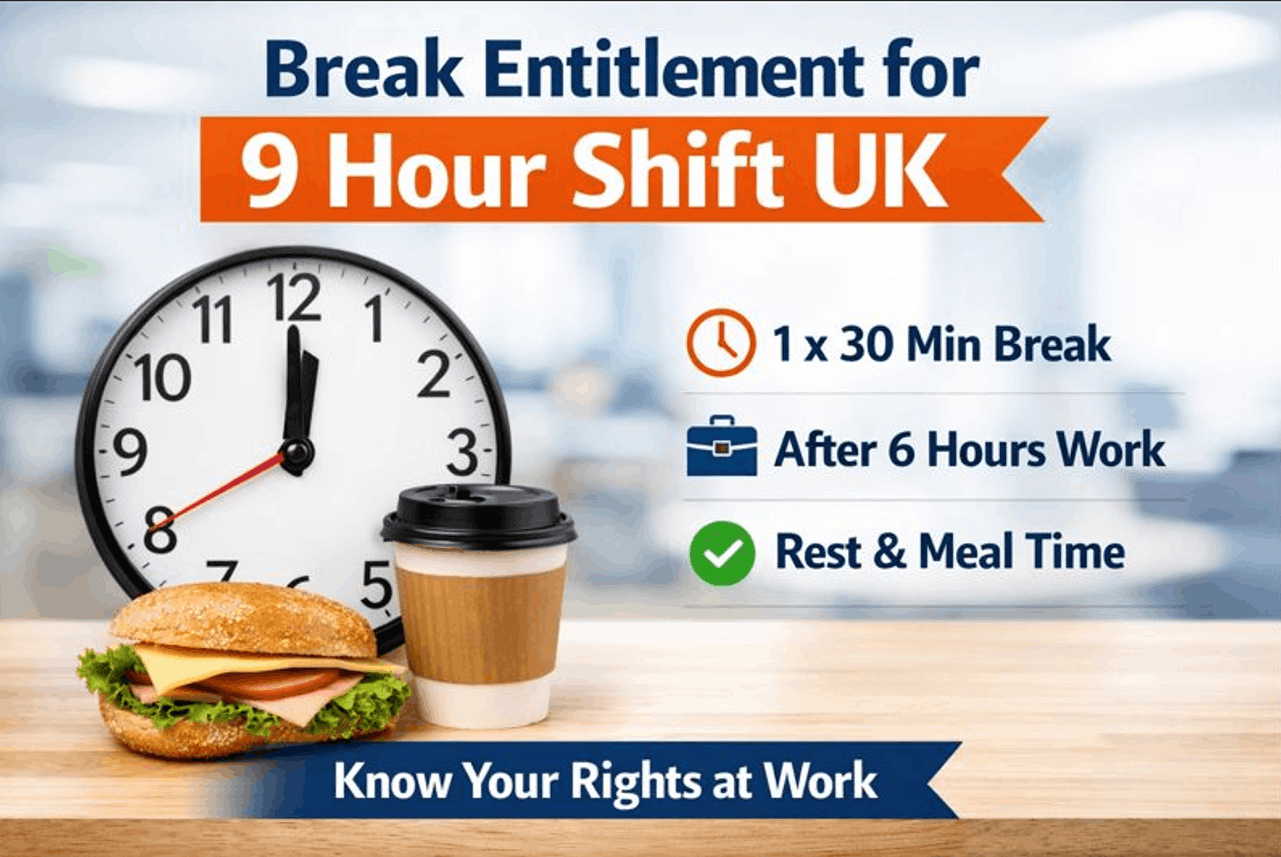
Break Entitlement For 9 Hour Shift UK: Legal Minimum, Paid vs Unpaid, Timing, Fixes
What is the break entitlement for a 9 hour shift?
For most people, break entitlement for 9 hour shift UK comes down to one core rule: when your working time exceeds 6 hours, you should get at least one uninterrupted rest break.
The part that trips people up is what counts as working time in the real world, especially when you’re on-site but not fully relieved. That’s also why how many hours can you work without a break comes up so often in workplace discussions.
On a typical 9-hour shift, you almost always cross that threshold, but the exact feel of your day depends on whether your shift includes an unpaid meal break, how the rota is built, and whether you can truly step away from duties.
Break entitlement for 9 hour shift UK usually means an uninterrupted 20-minute rest break once working time exceeds 6 hours. The break should happen during the working day, not placed at the start or end. Pay for the break is typically a contract and policy issue, not automatic.

What actually decides whether you get a proper break
The statutory minimum is the floor. What decides whether you actually get a proper break is coverage and control: who covers your role, whether there’s a handover routine, and whether managers treat breaks as scheduled time rather than when it’s quiet.
If you’re still answering calls, watching a queue, holding keys, or monitoring a radio, the break exists on paper but not in practice.
As of 2026, the workplaces that get this right tend to have one thing in common: a rota that builds in relief, even if it’s only a short swap.
Does a 9 hour shift mean you get more than one break?
A 9-hour shift does not automatically mean you’re entitled to multiple rest breaks. The minimum is typically one uninterrupted 20-minute break once you pass 6 hours of working time.
Anything beyond that often comes from your contract of employment, staff handbook, collective agreement, or operational risk controls, such as fatigue management.
The key point is this: the minimum is about eligibility; the real daily pattern is set by policy and the line manager’s scheduling choices. That’s why two people on identical shift lengths can have completely different break experiences.
A common pattern is that retail, hospitality, and warehouse teams offer a longer meal break because it’s workable for staffing, not because the law forces a longer duration.
A quick example from the shop floor
Sam works in a DIY store. His contract says a 45-minute meal break on long shifts. When a new supervisor started insisting, 20 minutes is enough, Sam pointed to the staff handbook. The rota was corrected within a week because the policy was more generous than the minimum.

Are breaks paid or unpaid on a 9 hour shift?
Whether you’re paid for a break is usually decided by contract and workplace policy. Many employers pay for short rest breaks but treat meal breaks as unpaid.
Some roles also have a paid break, but you stay on site rules, which can be fine if you’re genuinely free from duties, but it becomes messy if you’re regularly pulled back to work.
This is where payslips and clocking systems often muddy the picture. A shift can be nine hours on site, but only eight hours paid if there’s a one-hour unpaid meal break.
That difference isn’t necessarily a problem, as long as it matches the written terms and you’re genuinely able to take the break.
Paid and unpaid break setups at a glance
| Break setup | What it looks like on the rota | Typical payroll treatment | Practical risk to watch |
|---|---|---|---|
| Unpaid meal break | 30–60 minutes shown as a break | Unpaid time deducted | You’re expected to stay available |
| Paid rest break | Short break built into shift | Paid as normal hours | Break gets interrupted casually |
| Mixed policy | Paid short breaks + unpaid meal | Part paid, part unpaid | Staff confuse minimum vs policy |
| Automatic deductions | Break deducted regardless of use | Deducted every shift | You lose pay if the break isn’t taken |
If you’re trying to pin down your own position, focus on one question: Were you relieved of duties during the break, or were you still working in a different form?
When must the break be taken during a 9 hour shift?
A rest break is meant to happen during the working day, not as an admin trick at the edges. The cleanest approach is a mid-shift window that you can predict and plan around.
If you work slightly shorter days as well, the law on breaks at work 8 hour shift UK offers a useful point of comparison for how breaks are typically scheduled.
Employers often can set timing to suit operations, but the break should still function as a real pause rather than an early sign-on delay or an early finish.
If your breaks are repeatedly pushed into the last hour, or routinely scheduled in the first 30 minutes, that’s a red flag that the rota is treating breaks as a checkbox rather than rest.
In practice, the biggest improvement comes from treating breaks like handovers: a clear time slot plus a named cover person.
How it plays out on a real shift
Nadia works in a call centre. Breaks were technically anytime after 2 hours, but in reality they were always delayed by call spikes. Once the team introduced fixed break windows and a supervisor-managed queue handoff, missed breaks dropped sharply without increasing headcount.

How do you check your break entitlement for a 9 hour shift quickly?
To confirm break entitlement for 9 hour shift UK in your own job, you need three documents and two quick checks: your contract, the staff handbook or policy, and a recent rota or scheduling app record.
Then compare that against your timesheets or payslips to see whether break time is deducted and whether you actually took it.
This is also the safest way to raise concerns: you’re not arguing opinion, you’re comparing the written policy to what happens on the floor.
Step by step check you can do in ten minutes
- Pull your contract of employment and search for break, rest, or meal.
- Open the staff handbook or HR portal policy and note the break length for long shifts.
- Check your rota or scheduling app for whether breaks are pre-set or flexible.
- Compare with your timesheet or clock-in record to see if break time is deducted automatically.
- Look at one payslip and confirm paid hours match the shift minus unpaid breaks.
- For one week, note break start and finish times and whether you were interrupted.
- If there’s a mismatch, raise it with your line manager as a scheduling fix, not a complaint.
Take screenshots of the rota entries and keep notes factual, not emotional. That makes HR conversations far easier.
If your 9 hour shift includes lunch are you really working nine hours
Many workplaces describe shifts by on-site time, not paid working time. A 9-hour shift may include an unpaid meal break, so the paid working time could be eight hours.
This doesn’t remove the need for a rest break if you still work more than 6 hours, but it does change what you’re comparing when you talk about pay, overtime, and deductions.
If your payroll system auto-deducts a meal break but your team regularly works through it, that’s where problems escalate quickly. It’s also where managers often underestimate the issue, because the system makes it look like breaks happened.
In practice, the most common fix is operational: a short, scheduled relief swap so the deduction matches a real break.
If this same on-site versus paid-hours confusion shows up on longer days, the law on breaks at work 10 hour shift UK is a helpful comparison because deductions tend to stand out more.

What changes for young workers under 18 on long shifts?
Young workers typically have stronger protections, including longer rest breaks at shorter thresholds. If your workplace employs a mix of adults and under-18s, the rota needs to account for those differences.
This is especially relevant in hospitality, retail, and seasonal work where supervisors may schedule everyone the same way.
This section matters because many managers rely on habit. If they schedule a 17-year-old the same as an adult on a 9-hour shift, they can accidentally create a compliance gap even when they’re trying to be fair.
If you’re under 18, check the policy wording carefully and raise it early, ideally before the shift pattern becomes normal.
What to do when you cannot take breaks and compensatory rest applies?
Some roles cannot pause cleanly: lone working, security posts, care settings during medication rounds, or continuous operations with safety constraints.
In those contexts, employers sometimes use alternatives such as relief cover, handover protocols, or compensatory rest arrangements. The safe, practical approach is to ask for a documented method that matches your environment:
- Who covers you, and when?
- What happens during peak pressure?
- How missed breaks are recorded.
- How time back is arranged when relief is genuinely impossible?
In practice, when managers review near-misses and incidents, fatigue and missed breaks often show up as a repeating theme. That’s why many employers involve Health and Safety reps, risk assessments, and managers trained in incident reporting.
What counts as a real rest break and what does not?
A rest break should be a break from work. If you’re still responsible for customers, alarms, a till, a phone, or a clinical buzzer, you’re not properly relieved. The most common grey area is quiet monitoring: sitting down, but still required to respond immediately.
A practical test that avoids legal arguments is this: could you leave your workstation and be unreachable for the whole break without getting into trouble? If not, it’s worth discussing whether the break is actually functioning as rest.
Quick sense-check before you raise it:
- You can step away from duties without keeping an eye on anything
- You’re not required to answer calls or respond immediately
- Interruptions are the exception, not the routine
Keep it practical. The aim is a routine that works for the team, not a back-and-forth.

What to do if your employer keeps missing breaks on a 9 hour shift?
If missed breaks are occasional and explained, the fix is usually scheduling. If they’re frequent, you need a record and a process.
Start with your line manager and move through the internal route: HR, a union rep (if you have one), and the grievance procedure if needed.
If things escalate, terms like early conciliation and employment tribunal may appear in official guidance, but most cases improve well before that when the issue is described clearly and backed by notes.
A sensible next step is this:
- Raise one specific example with a proposed solution, such as a 20-minute cover swap.
- Ask for the policy position in writing via HR or the HRIS portal.
- Keep your record neutral: dates, times, and what interrupted the break.
What this looks like at work?
Imran worked nights in logistics. Breaks were when the conveyor slows, which often meant no break at all. He logged five shifts, then asked his supervisor to assign a floater for a 25-minute window. Once it was formalised, breaks became predictable and the team’s error rate improved.
What should you do if your break is always taken at the start or end?
If your break is consistently scheduled at the very start or end of a shift, treat it as a rota design issue. Ask for a mid-shift break window and propose how to cover your role. The more concrete you are about coverage, the faster this gets resolved.
Using your own words helps. For example: I’m happy to take the break whenever suits the team, but I need a slot where I’m fully relieved so it functions as rest.
How to discuss break entitlement without turning it into a dispute?
If you lead with I know my rights, conversations can get defensive fast. A calmer opener is: The rota shows a break, but I’m often interrupted, and payroll still deducts time. Can we adjust coverage so the break is real?
This keeps the discussion operational and avoids legal positioning. It also signals that you want a workable fix, not an argument.
If you’re searching break entitlement for 9 hour shift UK, that’s usually the exact gap you’re feeling: what the paperwork says versus what the shift delivers.

FAQs
What break are you legally entitled to on a 9 hour shift in the UK?
Most adult workers should receive at least one uninterrupted 20-minute rest break once working time exceeds 6 hours. On a 9-hour shift, that threshold is typically crossed. The break should be taken during the working day, not attached to the start or end of the shift.
Is the 20 minute break paid?
A rest break does not have to be paid automatically. Payment depends on your contract and workplace policy, and different employers handle meal breaks and short rest breaks differently. Check your contract, staff handbook, and payslip deductions to confirm whether break time is paid or unpaid in practice.
Do you get more than one break if you work nine hours?
Not automatically. Many workplaces provide more than one break through policy, collective agreements, or operational fatigue controls, but the minimum position is usually one uninterrupted break once you pass the relevant working-time threshold. Your rota and staff handbook are often the deciding documents for extra break time.
Can an employer tell you when to take your break?
Employers can usually set break times for operational reasons, but breaks should function as real rest during the working day. If breaks are routinely delayed until late in the shift, or placed at the start or end, raise it as a rota issue and propose a practical mid-shift window with cover.
Can your break be at the start or end of your shift?
A rest break is meant to be taken during working time and to provide recovery during the day. If the rota routinely places the break at the beginning or end, it may not serve that purpose. The most effective fix is requesting a mid-shift slot with a named cover plan.
Can your break be split into two 10 minute breaks?
Many people are offered split breaks by policy, but the minimum rest break is commonly described as uninterrupted. If your workplace only offers short breaks, ask whether you can take one continuous break so it clearly functions as rest. Keep the discussion practical: timing, cover, and interruptions.
What if you cannot take your break because of staffing?
If missed breaks happen repeatedly due to workload, record dates and what prevented the break, then raise it with a solution such as a cover swap or scheduled break window. In some roles, arrangements like compensatory rest or relief cover may be used to ensure adequate rest is still achieved.
Do agency workers and zero hours workers have the same break rights?
Break rules generally apply to workers, including many agency and zero-hours arrangements, but the practical details often sit in assignment terms, the agency contract, and site policy. Check what the agency and host employer say about breaks, and compare that to what happens on the floor and on payroll.
Final summary with next steps
For most people, break entitlement for 9 hour shift UK means at least one uninterrupted 20-minute rest break once working time exceeds 6 hours, taken during the working day. Pay is usually set by contract and policy. If your break exists only on paper, the fix is almost always a better rota and cover routine.
Next steps:
- Confirm whether your 9 hours include an unpaid meal break and whether payroll deducts it.
- Check your contract and staff handbook for enhanced breaks beyond the minimum.
- Log one week of real break times and interruptions.
- Ask for a mid-shift break window with named cover and a simple handover routine.
What people talk about this online
Break / Rest entitlements in the UK VS NZ
byu/Geck014 inUKJobs
Author expertise note
I’ve helped shift-based teams implement break policies that actually work on real rotas, aligning HR policy, payroll deductions, and health and safety routines. This is practical workplace information, not legal advice.