Break Entitlement for 4 Hour Shift UK: The Real Rules, Pay Deductions, Under-18 Rights and What to Do If You’re Refused
If you’re Googling break entitlement for 4 hour shift UK, you’re almost certainly trying to settle a simple workplace argument: “Am I legally owed a break on a 4-hour shift, yes or no?”
The honest answer is that UK law sets a minimum break right that usually doesn’t kick in at 4 hours for adults, but many UK employers still offer breaks on short shifts as a company policy (especially in retail and hospitality).
For most adult workers (18+) in the UK, a 4-hour shift does not trigger a legal (statutory) rest break. The legal right is an uninterrupted 20-minute rest break when your working day is more than 6 hours. Under-18s have different rules.
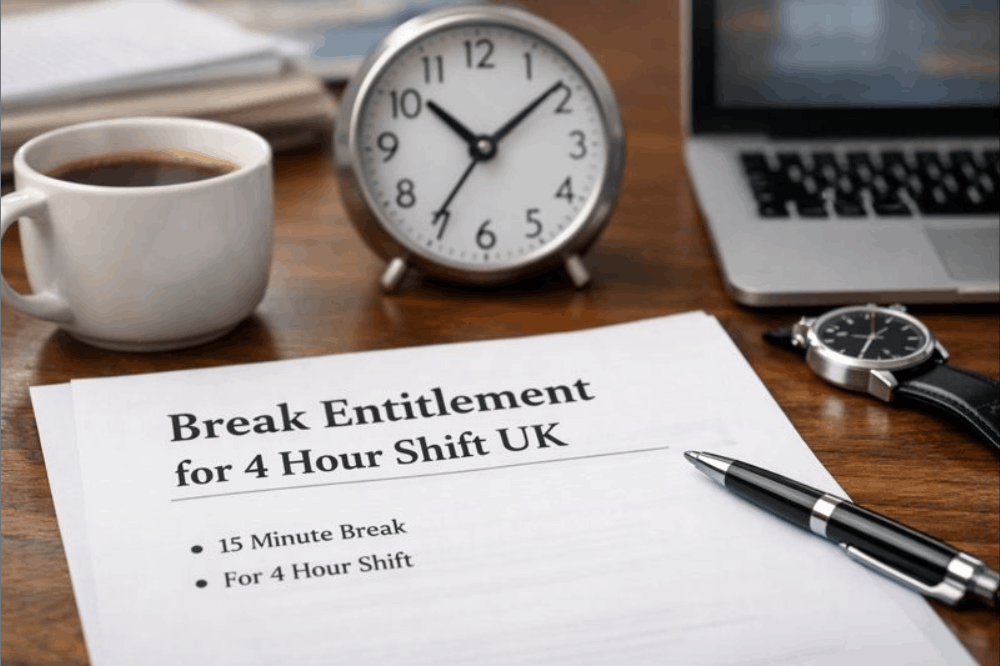
Break entitlement for 4 hour shift uk means whether UK law requires your employer to provide a rest break on a four-hour shift.
Under the Working Time Regulations, most adults are entitled to a legal rest break only when they work more than 6 hours in a day, although workplace contracts and policies often provide breaks on shorter shifts.
Break Entitlement for 4 Hour Shift UK: The Clear Legal Answer
If you are 18+ and working a 4-hour shift in the UK, you are usually not legally entitled to a rest break.
The statutory right is one uninterrupted 20-minute rest break when your daily working time is more than 6 hours, and it should be taken during the shift (not at the start or end). Under-18s are different: they’re entitled to a 30-minute rest break when working more than 4.5 hours.
Why This Trips People Up
Most workplace debates happen because people mix up two things:
- The legal minimum (what the law forces an employer to allow).
- Workplace policy (what your employer chooses to provide).
Plenty of UK workplaces give a short brew break on 4-hour shifts. That can be totally normal and fair, but it’s often policy, not statutory entitlement (for adults).

Do you get a break for a 4-hour shift in the UK (adult workers 18+)?
The rule
If you’re 18 or over, the legal minimum is one uninterrupted 20-minute rest break only when your daily working time is more than 6 hours. So, for most adults, 4 hours ≠ automatic legal break.
More than 6 hours is the detail that matters (6:00 vs 6:01)
This wording is where people get caught out in real rotas:
- 6 hours exactly (e.g., 10:00–16:00) → the statutory rest-break right does not trigger.
- 6 hours and 1 minute (e.g., 10:00–16:01) → the statutory rest-break right does trigger.
That single minute can change what you’re entitled to on paper, which is why accurate clock-in and clock-out times matter.
If you want a wider view of how UK break thresholds work across different shift lengths (not just a 4-hour shift), it’s worth reading How many hours do you have to work to get a break, it helps put the “more than 6 hours” rule into context alongside the break patterns employers commonly use in practice.
What if you’re under 18: does a 4-hour shift change the rules?
If you’re a young worker (above school leaving age and under 18), you get extra protection.
The “more than 4.5 hours” threshold and what it means on UK rotas
A young worker is entitled to a rest break of at least 30 minutes when daily working time is more than 4.5 hours.
So:
- 4:00 → not automatically a legal break (because it’s not more than 4.5).
- 4:31 → yes, legal 30 minutes applies.
Quick examples: how it shows up on UK rotas
| Shift length | Age 18+ legal rest break? | Under-18 legal rest break? | What many UK employers do anyway |
|---|---|---|---|
| 4:00 | No | No | Sometimes 10–15 minutes policy break |
| 4:30 | No | No (must be more than 4.5) | Often 10–15 minutes |
| 4:31 | No | Yes: 30 minutes | 30 minutes (often unpaid) |
| 6:01 | Yes: 20 minutes | Yes: 30 minutes | Usually 20–30 minutes |
Are breaks paid or unpaid in the UK?
What the law says vs what your contract may give you
Even when you qualify for the statutory rest break, the law generally gives you the right to take the break; it does not automatically require it to be paid. Whether breaks are paid is usually set by:
- Your employment contract.
- The staff handbook.
- Your employer’s break policy (sometimes location-specific).
How this plays out on real UK short shifts
When people search break entitlement for 4 hour shift UK, the real pain point is often pay deductions or inconsistent practices. On 4-hour shifts, employers commonly do one of these:
- No formal break and no deduction (common in office/admin short shifts).
- A paid 10–15 minute break (common in retail/hospitality policies).
- An unpaid 15–30 minute break (less common on 4 hours, but it happens in some places).
If your payslip shows a break deduction but you’re not genuinely relieved from duties, that’s a red flag worth raising.

Can your employer refuse a break or push it to the start/end?
The break should be taken during the shift
When the statutory rest-break right applies, the expectation is that it’s taken during the working day, not by starting later or finishing early. In day-to-day terms, that means:
- “Come in 20 minutes late instead” isn’t the same thing as a rest break during the shift
- “Leave 20 minutes early” isn’t the same thing either
A proper rest break should be a real pause from work: you’re relieved of duties and not expected to jump back in for customers or tasks.
Exceptions and compensatory rest: why some roles are handled differently
Some roles and working patterns have exemptions, where rest is provided in a different way (often called compensatory rest). If you’re in shift work with special arrangements, it can look different on paper, but the underlying idea is still that you’re not meant to be run into the ground without proper rest.
What UK employers often do on 4-hour shifts (common policies)
Even though a 4-hour shift usually doesn’t create a statutory break for adults, workplace policies often give breaks because it’s good for well-being, retention, and performance.
| Shift length | Legal minimum for age 18+ | Typical UK policy patterns |
|---|---|---|
| 4:00 | No legal rest break | 0 mins in some roles; or 10–15 minutes paid (common in retail/hospitality) |
| 5:00 | No legal rest break | Often 15 minutes paid or 30 minutes unpaid meal break |
| 6:00 | Not triggered (must be more than 6) | Often 20 minutes unpaid, sometimes 30 minutes |
| 6:01+ | 20 minutes uninterrupted | Usually 20–30 minutes (unpaid is common) |
| 8:00+ | 20 minutes uninterrupted | Often 30–60 minutes, sometimes split |
Examples: real rota scenarios
Retail (supermarket shop floor)
You’re rota’d 17:00–21:00. You may be offered a paid 15-minute break by policy because tills and floor work are relentless. For adults, that break often exists because the employer chooses to provide it, not because the law forces it at 4 hours.
Hospitality (pub/restaurant)
You’re rota’d 18:00–22:00. Some venues won’t schedule a formal break but allow “quick breathers”. Be careful: a “quick breather” isn’t the same as a proper rest break if you’re still expected to respond instantly to customers.
Care/support work
A short shift can be intense. Policies may schedule breaks for well-being, but staffing levels can squeeze them. In care roles, documenting missed breaks matters because the work can be safety-critical.

Does training, handover, opening or closing count toward your hours?
This is where 4 hours quietly turns into more than 4 hours in reality.
Common rota add-ons that can push you over the threshold
- You’re rostered 4 hours, but you’re expected in 10 minutes early for a briefing.
- You’re due to finish at 21:00, but you’re required to stay 15 minutes to cash up, lock up, or hand over.
- You’re told to clock out on time but still finish off tasks.
If the extra time is required and you’re still working, it can affect whether you cross key thresholds, especially for under-18s near 4.5 hours, or adults near 6 hours.
Step by step: what to do if breaks aren’t happening or pay is deducted
When break entitlement for 4 hour shift UK comes up, it usually boils down to one of these:
- You think you’re legally entitled to a break and aren’t getting it, or
- Your pay shows a break deduction, but you don’t actually get a proper break.
Here’s a practical workflow that works in the UK:
| Step | What you do | What you’re trying to prove | What to keep |
|---|---|---|---|
| 1 | Check contract + staff handbook | Does policy promise breaks for short shifts? | Contract clause, handbook screenshot |
| 2 | Confirm actual working time | Is it truly 4:00, or 4:20+ in reality? | Rotas, clock-in/out, messages |
| 3 | Raise it informally | Ask how breaks are scheduled and recorded | Notes after the chat |
| 4 | Put it in writing | Clear dates, times, and what you’re requesting | Email/message thread |
| 5 | Escalate properly if needed | Follow grievance steps / get advice | Copies of everything |
A useful next step: write down your last two weeks of actual start/finish times (including early briefings and late handovers). That one step usually clears up most arguments quickly.
Common mistakes on 4-hour shifts and the edge cases that matter
These are the mistakes that tend to cause the same argument again and again:
- Assuming “we all get 15 minutes, so it must be law” (often it’s policy).
- Thinking the rule is “20 minutes for every 6 hours” (it isn’t phrased like that; the trigger is more than 6 hours).
- Accepting “take it at the end” as the legal rest break (a rest break is meant to be during the shift).
- Not noticing the shift is longer in reality (briefings, handovers, cashing up).
Edge cases that matter in the UK:
- Under-18s: 4:31 is a big deal because it can trigger 30 minutes.
- Near 6 hours for adults: 6:01 can trigger the statutory 20 minutes.
- Break deductions: if time is deducted but you weren’t properly relieved from duties, that’s a separate dispute worth documenting.

Quick reference: UK legal break thresholds
| Working time in the day | Age 18+ legal rest break | Under-18 legal rest break |
|---|---|---|
| Up to 4:30 | No | No |
| More than 4:30 | No | 30 minutes |
| More than 6:00 | 20 minutes uninterrupted | 30 minutes |
Why many UK employers offer more than the legal minimum
Even when the law doesn’t force a break at 4 hours for adults, short shifts can still be demanding, especially in customer-facing jobs. That’s why many UK employers build in short breaks for fairness and fatigue management, even on 4-hour shifts. In practice, this is also about retention: people are more likely to stay in a job that feels humane.
How people talk about this online
Bottom line
If you’re searching break entitlement for 4 hour shift UK, here’s the bottom line: most adults aren’t legally owed a rest break at 4 hours, because the statutory right starts at more than 6 hours. Under-18s are different: more than 4.5 hours triggers a 30-minute break. Everything else on 4-hour shifts is usually workplace policy, so your contract, handbook, and actual clocked time matter just as much as the legal minimum.
FAQs
Is a 15-minute break legal on a 4-hour shift in the UK?
Yes. For adults, it’s usually a policy benefit, not a legal requirement, at 4 hours. The law sets a minimum; employers can always offer more.
Can my employer refuse breaks entirely?
If you meet the statutory thresholds (adults more than 6 hours, under-18s more than 4.5 hours), you should be allowed the rest break. If you don’t meet the threshold, your entitlement may depend on your contract and policies.
Are breaks paid in the UK?
Breaks don’t have to be paid by default under the legal minimum rules. Payment depends on your contract and employer policy.
Can I take my break at the end of the shift and go home early?
That’s not how a proper rest break is supposed to work. A rest break should be taken during the shift so you can actually rest.
Author note
This guide was written by a UK workplace content specialist who regularly translates Working Time Regulations and ACAS-style guidance into practical, plain-English steps for employees and managers. It’s designed to help you understand break entitlement for 4 hour shift UK in real rota situations (retail, hospitality, care) without jargon. This is general information, not legal advice. If your situation is complicated, speak to your HR team, ACAS, or a qualified adviser.