How Much Mortgage Can I Get in the UK? Use a Mortgage Affordability Calculator, Key Factors Lenders Check
If you’re asking how much mortgage can i get in the UK, here’s the straight answer most people need first: Most UK lenders will typically lend around 4 to 4.5 times your annual household income, but your real maximum is set by affordability checks (your outgoings, debts, deposit/LTV, credit history, and stress-testing at higher interest rates).
That’s why a mortgage affordability calculator is useful: it estimates what you might be able to borrow and what the monthly payments could look like, then you refine it using your real spending and lender-style checks.
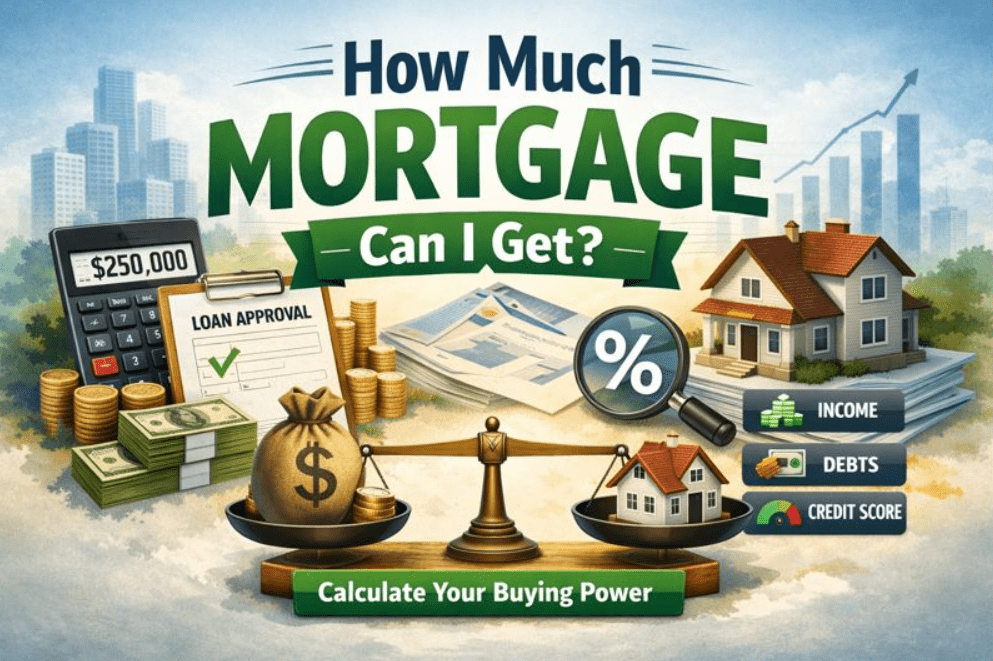
How much mortgage can I get in the UK? Use a mortgage affordability calculator to find your realistic range
When you search how much mortgage can I get, you’re really looking for two numbers:
- The maximum a lender might offer (subject to underwriting)
- The maximum you can comfortably afford (without your budget feeling squeezed)
A mortgage affordability calculator helps you quickly determine a starting range. Still, the most accurate result comes when you combine it with (a) real monthly outgoings and (b) the way lenders assess risk.

Mortgage affordability calculator (UK)
Mortgage Affordability Calculator (UK)
Estimate your maximum mortgage based on affordability (monthly budget) and an income-multiple cap. This is a guide only; lenders apply their own criteria and stress tests.
How lenders decide your maximum mortgage?
UK lenders don’t only look at your income. They run an affordability assessment designed to answer: If rates rise, and life happens, can you still pay?
In practice, most affordability checks boil down to five pillars:
- Income (how stable it is and what counts)
- Outgoings (committed debts and everyday spending)
- Deposit and LTV (how risky the loan is relative to the property value)
- Credit profile (your payment history and current credit usage)
- Stress testing (whether repayments remain affordable at a higher rate)
If one pillar looks weak (high debts, high childcare, low deposit, poor credit history), your maximum borrowing can fall well below the “income multiple” number.

How to use a mortgage affordability calculator in the UK?
A mortgage affordability calculator is only as good as the inputs you give it. If you use “best case” figures, you’ll get a “best case” result, which often collapses when a lender reviews bank statements.
Use this simple approach:
- Start with your annual gross income (or combined income if applying jointly)
- Add regular outgoings honestly (debts, childcare, travel, bills)
- Choose a term you could live with (often 25–35 years)
- Test payments at today’s likely rate, then test again at a higher rate
- Keep the number that still leaves you comfortable each month
Here’s what you should gather before you run any calculator (this prevents most “why did the lender offer less?” surprises):
- Your last 3–6 months’ typical spending (a banking app export works)
- Exact debt payments (credit cards, loans, car finance, BNPL)
- Childcare and commute costs (often the biggest affordability reducers)
- Your deposit amount and an estimated property price (to calculate LTV)
- Any variable income proof (bonus, overtime, commission, self-employed figures)

What is an income multiple, and why does it still matter?
Income multiples are the quick shorthand people use to estimate borrowing power. A very common rule of thumb in the UK is roughly 4 to 4.5× household income as a starting range, but it’s not a guaranteed offer, and it’s not the whole story. Some applicants may qualify for more, and many will qualify for less, depending on affordability.
A rough income-multiple guide
| Household gross income | 4× income (rough) | 4.5× income (rough) | Why your real max can differ |
|---|---|---|---|
| £30,000 | £120,000 | £135,000 | childcare, debts, high LTV, short term |
| £40,000 | £160,000 | £180,000 | credit commitments, variable income limits |
| £50,000 | £200,000 | £225,000 | stress test rate, deposit size, lender model |
| £70,000 | £280,000 | £315,000 | dependants, high fixed outgoings, existing loans |
| £100,000 | £400,000 | £450,000 | income structure, bonuses, other properties |
Use this table to get your first number. Then use affordability logic to find your real number.
How much mortgage can I get based on my salary?
This is the most common question, and the best way to answer it is a two-step method:
Step 1: Estimate a range using income multiples
- Take your gross household income and multiply it by 4 to 4.5 for a rough range.
Step 2: Convert that range into monthly payments and test your budget
- A mortgage that looks “approved” on paper can still feel miserable if it eats your monthly cash flow.
A practical way to sanity-check affordability is to ask:
- After mortgage + bills + food + travel + childcare + debt payments, do you still have space for savings and surprises?
- If the interest rate rose and your payment jumped, would you still be okay?
If you want your calculator result to behave more like a lender’s view, don’t just enter bills. Include the commitments lenders care about most.
What outgoings reduce your mortgage affordability the most?
Some outgoings hit affordability harder than people expect because they’re either fixed (can’t easily be cut) or long-term (exist throughout the mortgage period).
Common affordability “heavy hitters” include:
- Childcare
- Car finance (PCP/HP) and personal loans
- Credit card balances (especially if you’re only paying minimums)
- High commuting costs
- Maintenance payments
- High essential bills (energy, council tax, insurance, service charges)
A useful mindset is this: lenders don’t only ask “can you pay today?” They ask, can you pay consistently?

Gross pay vs take-home pay: which one matters more?
Most affordability systems begin with gross income because it’s standardised. But your real life runs on take-home pay, and that’s what you should use to judge comfort.
Here’s the best compromise:
- Use gross income to estimate what lenders might consider
- Use your actual monthly take-home to decide what you should accept
If you only rely on gross-based calculators, you may overestimate what feels affordable once pension contributions, student loans, childcare, and real spending are included.
Deposit and LTV: why your deposit changes both acceptance and cost
Deposit affects more than how much you need upfront. It often changes:
- Which products you can access?
- The interest rate you’ll pay.
- Whether the lender sees the loan as higher risk?
The key concept is loan-to-value (LTV): the percentage of the property price you’re borrowing.
Typical UK deposit/LTV bands (simplified)
| Deposit | LTV | What it often means in practice |
|---|---|---|
| 5% | 95% | fewer deals, usually higher rates, stricter affordability feel |
| 10% | 90% | more choice, often better pricing than 95% |
| 15% | 85% | noticeably better choice and rates for many borrowers |
| 25% | 75% | strong access to competitive deals |
| 40% | 60% | typically among the best-priced tiers |
Two people on the same income can have very different how much mortgage can I get outcomes just because one has a higher deposit (lower LTV) and can access better rates.
Interest rates and stress testing: why your max can shrink suddenly?
Even if your income hasn’t changed, your maximum borrowing can change because lenders stress-test affordability. In plain English, they test whether you could still afford the mortgage if rates were meaningfully higher.
What you can do next:
- Run your mortgage affordability calculator at a realistic current rate
- Then increase the rate assumption and see if the payment still fits your life
If the higher-rate scenario breaks your budget, it’s a sign your “comfortable max” is lower than your “calculator max”.
Mortgage term: Can a longer term help you borrow more?
Often, yes, because spreading the loan over more years reduces the monthly payment, which can improve affordability.
But it’s not a free win. A longer term can:
- Increase total interest paid
- Keep you in debt longer
- Reduce flexibility later
A sensible approach:
- Choose a term that keeps payments comfortable without relying on “everything going perfectly” for decades.
Joint applications: Does a second income always increase borrowing?
It often increases borrowing power, but not always. A joint mortgage can be held back if one applicant brings:
- High debts (car finance, loans)
- High committed spending
- Poor credit history
- Multiple dependants
Also, some lenders consider the combined situation conservatively. So yes, adding income helps, but adding liabilities can cancel the benefit.
How much mortgage can I get if I’m self-employed?
Self-employed borrowers can absolutely get mortgages in the UK, but the calculation is often more evidence-driven. Lenders typically want to see:
- A stable earnings pattern (often over multiple years)
- Consistency between your accounts and your lifestyle spending
- Clear documentation (accounts, SA302s/tax year overviews, depending on lender)
What changes for self-employed applicants is not the concept of affordability; it’s how the lender counts income. For example:
- Some lenders may average multiple years.
- Some may take the most recent year (if it’s lower or higher, it matters).
- Some may treat retained profits and dividends differently.
Practical tip: when using a mortgage affordability calculator as a self-employed applicant, test multiple income assumptions (e.g., last year, averaged years) so you don’t anchor on a best-case number.

How your credit profile influences how much you can borrow?
Credit doesn’t just decide “yes/no”. It can influence:
- Which lenders consider you?
- Which rates you’re offered?
- How strict affordability feels?
Common issues that reduce options:
- Missed payments or defaults.
- High credit utilisation (using a large % of your available credit).
- Lots of recent credit applications.
- Carrying large revolving balances month-to-month.
If you’re planning to apply soon, the safest strategy is usually:
- Avoid taking on new credit.
- Reduce revolving balances where possible.
- Keep payments squeaky clean.
How much mortgage can i get with a £20,000 deposit and why the property price matters?
This is where people get caught: the deposit amount alone isn’t enough to answer the question. It depends on the property price because the deposit drives LTV.
Example logic:
- If £20,000 is 10% deposit → property price ~£200,000 → LTV ~90%
- If £20,000 is 5% deposit → property price ~£400,000 → LTV ~95%
- If £20,000 is 20% deposit → property price ~£100,000 → LTV ~80%
Same deposit, very different deal access and interest rates, which affects affordability and therefore how much a lender is willing to offer.
Agreement in Principle: the step that makes it feel real
After you’ve used a mortgage affordability calculator and found a comfortable range, the next step many buyers take is an Agreement in Principle (also called a Decision in Principle).
It’s not a guaranteed offer, but it:
- Checks your eligibility more formally.
- Gives estate agents confidence you’re serious.
- Helps you avoid falling in love with homes outside your realistic range.
Let’s explore this in a practical way: treat the calculator as planning, and the AIP as validation.
How to increase your mortgage affordability without stretching yourself too far?
If you want to improve the number you can borrow, focus on the levers lenders respond to most. Here are high-impact moves (choose what fits your life rather than doing everything at once):
- Reduce committed debts (car finance, loans, credit card balances)
- Increase the deposit to move into a better LTV band
- Adjust term to improve monthly affordability (while understanding the total cost)
- Improve documentation for variable/self-employed income
- Tighten up spending consistency before application (bank statements matter)
A useful rule: Improving affordability is often easier than earning more quickly, because reducing fixed commitments can change lender affordability models immediately.
Common mistakes that make calculator results look better than reality
Mistake 1: Underestimating spending
People often forget annual and irregular costs: insurance renewals, gifts, car maintenance, holidays, subscriptions, and service charges.
Mistake 2: Ignoring rate changes
If your budget only works at the lowest possible rate, your plan is fragile.
Mistake 3: Confusing max offered with smart to take
The lender’s maximum is a risk-based decision. Your personal maximum should be comfort-based.
What should you budget for beyond the mortgage payment?
To make this guide truly complete, it’s important to remember that owning a home costs more than the mortgage. Typical ownership costs include:
- Buildings insurance (and contents insurance)
- Council tax
- Utilities
- Maintenance and repairs
- Service charge/ground rent (for many leaseholds)
If you don’t include these in your affordability thinking, your how much mortgage can i get number may be technically achievable, but practically stressful.
A simple realistic range method you can do today
If you want a reliable process (without becoming a mortgage expert), do this:
- Use a mortgage affordability calculator to generate an initial range
- Cross-check using an income multiple estimate (4–4.5×) so you know the “headline” range
- Convert the loan amount into monthly payments and run two scenarios:
- A today’s rate scenario
- A higher rate scenario
- Choose the amount that still leaves you comfortable after all your real-life costs
- Validate with an Agreement in Principle
This approach keeps you grounded: you’ll know what you might get, and what you’ll actually enjoy living with.
What do people speak about this online?
View this post on Instagram
View this post on Instagram
22yo, Excellent Credit, £29,785 Salary – How Much Can I Realistically Borrow for a Mortgage?
byu/Consistent-Ad-7455 inUKPersonalFinance
Combined income of £43,000. What realistic mortgage can I afford?
by inUKPersonalFinance
Is this really how little mortgage I can get?
byu/Slow-Razzmatazz-4005 inUKPersonalFinance
Mortgage fixed rates, can someone explain please
byu/Next-Dimension-1092 inHousingUK
Conclusion: the best way to answer “how much mortgage can i get” with confidence
To answer how much mortgage can i get in a way Google recognises (and your future self will thank you for), you need both the quick estimate and the deep check:
- Start with a mortgage affordability calculator to get a range
- Sanity-check that range with an income multiple estimate
- Stress-test your monthly budget at a higher rate
- Validate it with an Agreement in Principle
- Choose the number that keeps your life comfortable, not just approved
Here’s what you can do next: if you share your household income, deposit, rough monthly outgoings, and whether you’re employed or self-employed, I can show you a realistic borrowing range and what’s driving it (without pretending it’s a lender decision).
FAQ
Is the 4.5× income rule guaranteed?
No. It’s a common starting point, but lenders will reduce (or sometimes increase) it based on affordability, deposit, credit profile, and stress testing.
Do lenders look at take-home pay or gross income?
They usually start with gross income, then model affordability using outgoings and stress testing. For your personal comfort, take-home pay is the reality check.
Can I borrow more with a longer term?
Often yes, because it reduces monthly payments, but it usually increases total interest over time. Make sure the trade-off fits your goals.
Does having children reduce how much I can borrow?
It can, because childcare and dependent-related spending often materially reduces affordability.
Why do different calculators give different answers?
Because they assume different interest rates, outgoings, and lender-style stress tests and because people enter different levels of detail.
Author expertise note
This article is written from the perspective of analysing how UK affordability assessments are commonly structured (income, outgoings, LTV, credit, and stress testing) and translating that into practical steps homebuyers can use before speaking to a lender or broker. This is general information, not financial advice.