
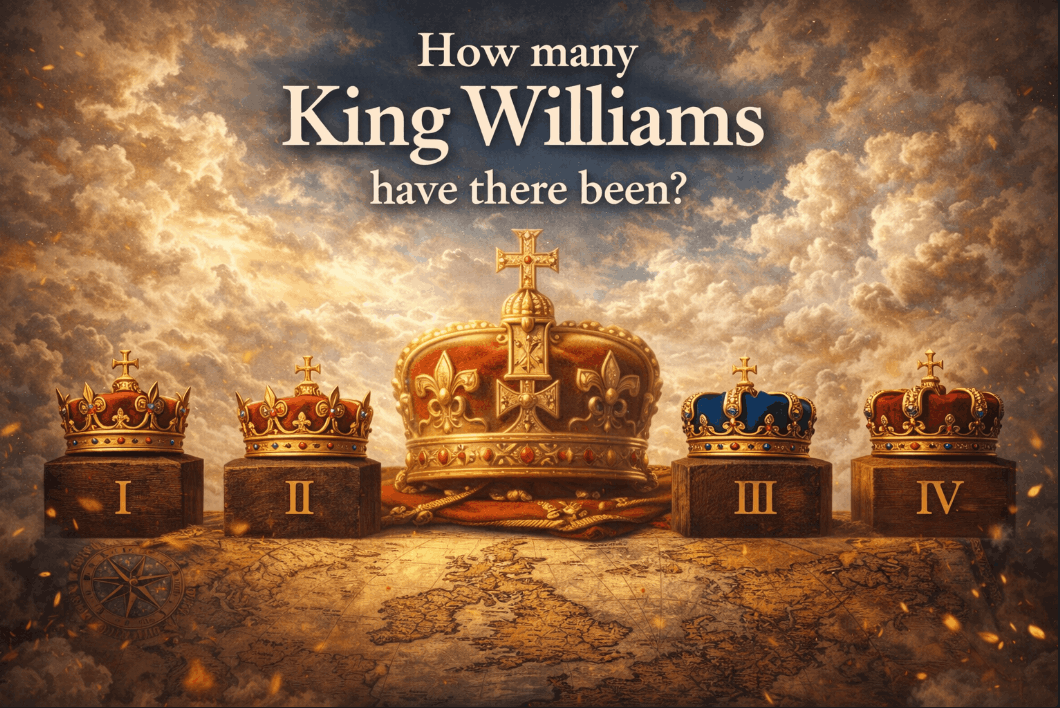
How Many King Williams Have There Been? The Complete Guide To England And Scotland’s Royal History
There have been four Kings of England and the United Kingdom named William since the Norman Conquest in 1066. While William I, II, III, and IV are the recognised English monarchs, Scotland also had an independent King William I, known as William the Lion, who reigned from 1165 to 1214.
The name William remains one of the most significant regnal names in British history, marking the transition from Anglo-Saxon rule to the Norman era and later defining the shift toward a constitutional monarchy.
Tracing the lineage of these monarchs requires a look at how the English and Scottish crowns evolved separately before their eventual unification under a single sovereign.
How many King Williams have there been in British history?
There have been four monarchs named William who sat on the English or British throne. These include William the Conqueror (1066), William Rufus (1087), William of Orange (1689), and William IV (1830).
Additionally, Scotland acknowledges William the Lion as their own William I, though he is not counted in the standard UK regnal numbering.
The Distinction Between English and Scottish Lineages
The total count of King Williams depends entirely on whether the focus remains on the English succession or incorporates the broader history of the British Isles.
The numbering system used today follows the English succession. This is why the next Prince William will be known as William V, despite Scotland having only seen three previous Williams (William the Lion, William II/III, and William IV).
The recurring nature of the name ‘William’ highlights its role as a focal point for major structural changes in the British state, from the first census to the Great Reform Act.
What was the legacy of William I the Conqueror?
As the first Norman King of England, William I (reigned 1066–1087) fundamentally restructured the English economy and legal system.
His victory at the Battle of Hastings replaced the Anglo-Saxon aristocracy with a new Norman ruling class, a change that still influences British land ownership and the English language today.
The First National Audit: The Domesday Book
In 1086, William I commissioned the Domesday Book. In practice, this was the world’s first comprehensive business and asset audit.
By recording every piece of land, livestock, and resource across the kingdom, he established a precedent for national taxation and data collection that modern SMEs would recognise as the ancestor of the modern tax return.
This early emphasis on rigorous organisation laid the groundwork for the British commercial spirit that still thrives today.
It is a lineage of leadership seen in everything from historic family estates to modern entrepreneurial success stories, such as the plumbing empire established by the Pimlico Plumbers owner. Both royal and industrial legacies continue to shape the UK’s economic identity.
Key Milestones of the Norman Conquest
- 1066: The invasion and victory at the Battle of Hastings.
- 1070: Commencement of the Tower of London to secure the capital.
- 1086: Completion of the Domesday Book survey.
- Feudalism: Implementation of a strict hierarchy where all land was technically owned by the Crown.
Why is William II known as the Red King?
William II (reigned 1087–1100), the son of the Conqueror, is commonly referred to as William Rufus due to his ruddy complexion or red hair.
His reign was marked by conflict with the Church and the nobility. Unlike his father, his legacy is often overshadowed by the suspicious circumstances of his death.
| Feature | William I (The Conqueror) | William II (Rufus) |
| Reign Start | 1066 | 1087 |
| Primary Achievement | Unified England under Norman rule | Consolidated borders against Scotland |
| Relationship with Church | Generally cooperative | Highly antagonistic |
| Death | Natural causes (riding accident) | Arrow wound (hunting accident) |
Historically, a hunting accident often served as a convenient explanation for a political assassination; Rufus’s death in the New Forest remains one of the era’s most debated cold cases.
Who was William the Lion of Scotland?
While not part of the English numbering, William I of Scotland (reigned 1165–1214) is essential to the William count in the British Isles.
He was a contemporary of Henry II of England and is famous for his attempts to reclaim Northumberland, which led to his capture and the temporary loss of Scottish independence under the Treaty of Falaise.
The Process of Regnal Numbering in Scotland
- Independent Counting: Scotland maintained its own numbering until the Union of the Crowns.
- The Lion Rampant: William I is credited with adopting the red lion as the Royal Banner of Scotland.
- Conflict: His reign saw frequent skirmishes along the border.
- Church Status: He secured the Special Daughter status for the Scottish Church from the Pope.
- Economic Growth: He granted charters to several major Scottish burghs.
- Succession: He was succeeded by his son, Alexander II.
How did William III change the British Constitution?
William III (reigned 1689–1702), also known as William of Orange, was a Dutch prince who took the throne during the Glorious Revolution.
He ruled jointly with his wife, Mary II. His arrival was not just a change of personnel but a fundamental shift in the contract between the monarch and the people.
The 1689 Bill of Rights
William III accepted the Bill of Rights, which limited the power of the monarchy and established the supremacy of Parliament. For the first time, the King could not raise taxes or keep a standing army without Parliamentary consent.
This created the stable legal environment necessary for the later Industrial Revolution and the growth of British trade.
| Monarch | William III (England/Ireland) | William II (Scotland) |
| Alternative Title | Prince of Orange | King of Scots |
| Core Conflict | Jacobite Risings | Battle of the Boyne |
| Legacy | Bank of England founded (1694) | Settlement of the Presbyterian Church |
What role did William IV play in modernising Britain?
William IV (reigned 1830–1837) was the last of the Hanoverian Williams. Often called the Sailor King due to his career in the Royal Navy, his reign was short but transformative. He presided over a period of intense social and political pressure that threatened to boil over into revolution.
The Great Reform Act of 1832
When reviewing decisions made during the 1830s, the most significant was William IV’s reluctant support for the Reform Act. This legislation abolished rotten boroughs and gave more representation to the new industrial cities like Manchester and Birmingham.
It was the first major step toward a modern democratic system, ensuring the survival of the monarchy by adapting to a changing society.
Summary of the Four English Williams
| Name | House | Reign Dates | Major Milestone |
| William I | Norman | 1066–1087 | The Norman Conquest |
| William II | Norman | 1087–1100 | Border Consolidation |
| William III | Orange/Stuart | 1689–1702 | The Bill of Rights |
| William IV | Hanover | 1830–1837 | The Reform Act |
Will Prince William become King William V?
The current Prince of Wales is expected to eventually ascend the throne as King William V. This will be a significant milestone, as he will be the first William to reign in over 190 years.
While a monarch can choose any of their middle names as their regnal name (Prince William’s full name is William Arthur Philip Louis), it is widely expected that he will retain William.
This choice reinforces a sense of continuity and connects the future of the monarchy back to its 11th-century roots. From a Royal Brand perspective, William V represents a bridge between the ancient traditions of the Conqueror and a modern, 21st-century Commonwealth.

Final Summary
The history of the Williams is the history of Britain’s evolution. From the military conquest of William I to the constitutional reforms of William III and William IV, each monarch has reigned during a pivotal turning point for the nation.
Grasping the ‘four plus one’ rule, noting the four English/UK monarchs alongside Scotland’s independent king, provides a clear map through a millennium of royal history.
To see how the British throne moved beyond the era of the Williams, a natural progression is to explore the subsequent Victorian age or the eventual rise of the House of Windsor.
FAQ
Who was the last King William?
The last King William was William IV, who reigned from 1830 to 1837. He was the uncle of Queen Victoria and was known for his naval career and for overseeing the abolition of slavery in most of the British Empire.
Is Prince William related to William the Conqueror?
Yes, Prince William is a direct descendant of William the Conqueror. The lineage spans nearly 1,000 years through various branches of the Royal Family, including the Houses of Plantagenet, Tudor, Stuart, and Hanover.
Why was William III called William of Orange?
William III was a member of the House of Orange-Nassau, a princely dynasty from the Netherlands. He was the Stadtholder of the Dutch Republic before being invited to take the English throne in 1688.
Was there ever a King William V?
No, there has not yet been a King William V. The numbering currently stops at William IV. Prince William, the current Prince of Wales, is the likely candidate to become the first King William V.
How many King Williams were there in Scotland?
Scotland had one exclusive King William (William the Lion). However, William of Orange was known as William II in Scotland, and William IV was also King of Scotland following the Act of Union.
Who was the longest-reigning King William?
William the Lion of Scotland reigned for 48 years (1165–1214), making him the longest-reigning William in British history. Among the English Williams, William the Conqueror reigned the longest at 21 years.
What happened to William II?
William II died from an arrow wound while hunting in the New Forest in 1100. It is widely debated whether it was an accident or an assassination orchestrated by his brother, who became Henry I.
Why do some lists only show four Williams?
Most lists focus on the English/UK regnal line, which counts William I, II, III, and IV. They exclude William the Lion because he reigned over Scotland before the two crowns were unified.